UGC's AI Disclosure Rule: What Every PhD Scholar Must Know About AI and Academic Integrity
Artificial Intelligence has rapidly become part of the modern research workflow.
Researchers use AI tools for:
• Language improvement
• Literature discovery
• Summarization
• Brainstorming
• Reference organization
• Draft refinement
However, a recent development in India's higher education ecosystem has sparked widespread discussion among researchers.
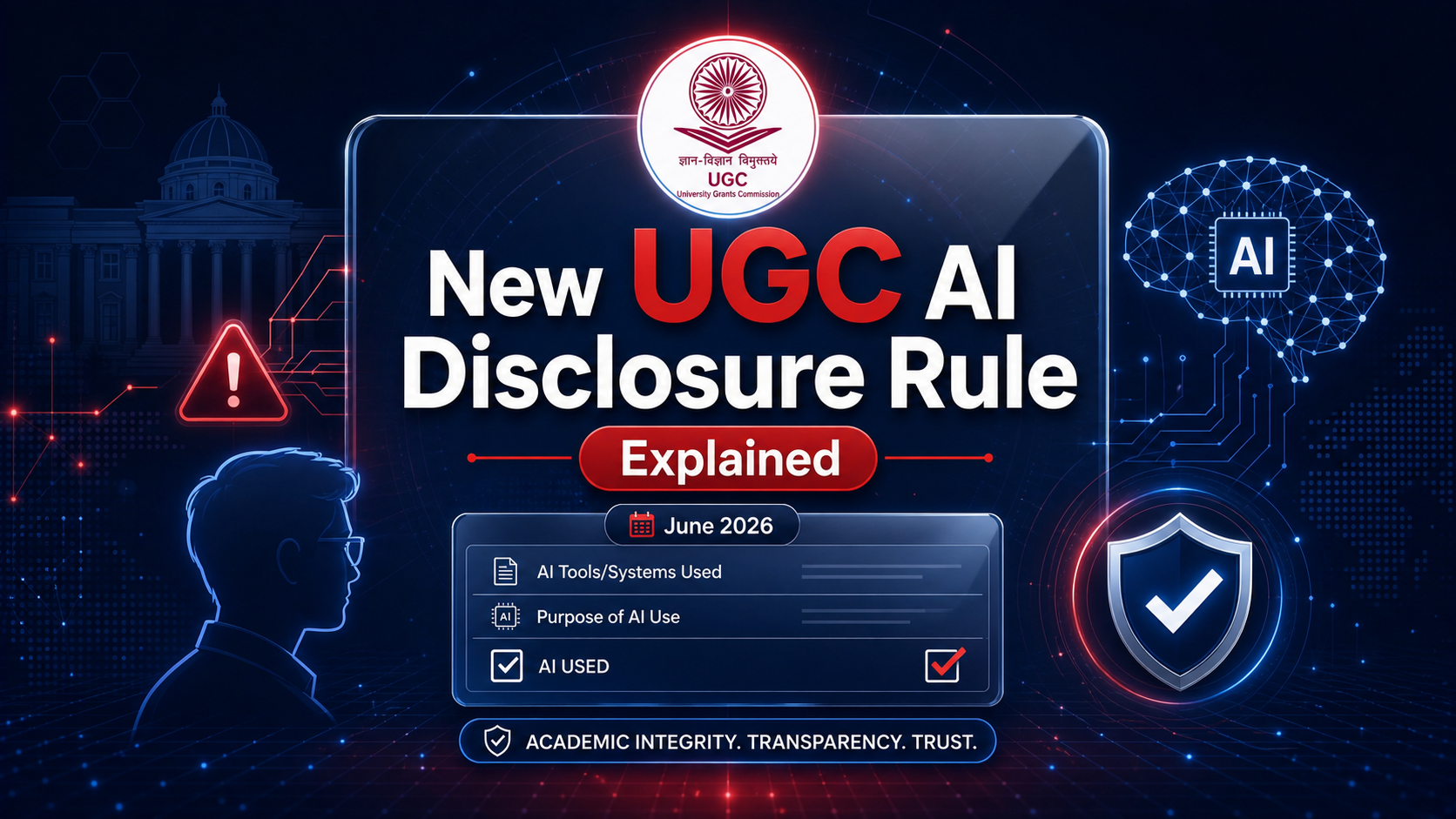
According to revised UGC norms reported this week, unacknowledged use of AI in PhD work may be treated as a form of plagiarism. This represents one of the clearest signals yet that transparency around AI usage is becoming a core requirement of academic integrity in India.
For researchers, the message is simple:
Using AI is not necessarily the problem. Failing to disclose its use may be.
What Has Changed?
Recent reports indicate that the University Grants Commission (UGC) has revised its approach toward AI-assisted academic work.
Under the updated norms, researchers are expected to acknowledge the use of AI tools when such tools contribute to thesis preparation, content generation, or other research-related activities. Undisclosed AI-generated material may be considered plagiarism because it presents externally generated content as original scholarly work.
The emphasis is not on banning AI.
The emphasis is on transparency.
Most Important: UGC's Similarity & AI Content Thresholds
According to the revised UGC framework, the consequences depend on the percentage of AI-generated content and plagiarism detected in a PhD thesis.
Similarity Between 10% and 40%
If a thesis contains 10% to 40% AI-generated content or plagiarism, it may be returned to the researcher for revision.
The scholar may be required to revise and resubmit the thesis within six months.
Similarity Between 40% and 60%
If the similarity level falls between 40% and 60%, the researcher may be barred from submitting the thesis for one year.
This can significantly delay degree completion and academic progress.
Similarity Above 60%
If the overlap exceeds 60%, the consequences become much more serious.
UGC guidelines indicate that the PhD registration itself may be cancelled.
What Researchers Should Understand
The objective is not to prohibit technology.
The objective is to ensure that the intellectual contribution remains the researcher's own.
UGC has clarified that the core content of a PhD thesis must be written by the scholar.
AI may be used only for limited assistance such as:
• Language correction
• Grammar improvement
• Readability enhancement
• Minor editorial support
Researchers should not rely on AI systems to generate substantial portions of their thesis, literature review, discussion, analysis, or conclusions.
At BSWS, we recommend treating AI as a research assistant rather than a research author.
The ideas, interpretation, methodology, critical analysis, and scholarly contribution should always originate from the researcher.
Why Is UGC Taking This Position?
Academic research is built on three fundamental principles:
• Originality
• Attribution
• Accountability
When researchers cite journal articles, books, datasets, or software tools, they acknowledge the source of assistance.
The same logic increasingly applies to AI systems.
UGC's position reflects a broader global trend where universities and publishers are developing policies requiring disclosure of AI-assisted content while preserving human responsibility for the final work.
Does This Mean Researchers Cannot Use ChatGPT?
No.
The revised approach should not be interpreted as a prohibition on AI tools.
In fact, many academic institutions now recognize that AI can support research productivity when used responsibly. Discussions within higher education increasingly focus on disclosure, verification, and responsible usage rather than outright bans.
The key distinction is:
Acceptable Use
• Grammar improvement
• Language polishing
• Summarization assistance
• Brainstorming research questions
• Draft organization
• Coding assistance
Risky Use
• Submitting AI-generated text as original work
• Using AI-generated analysis without verification
• Presenting AI-generated interpretations as personal scholarship
• Failing to disclose substantial AI assistance
The responsibility for accuracy, originality, and scholarly judgment remains with the researcher.
Why Disclosure Matters
Many researchers assume that if they edit AI-generated text, disclosure becomes unnecessary.
However, the concern extends beyond wording.
Academic integrity requires transparency about how research outputs were produced.
Proper disclosure helps:
• Maintain trust in scholarship
• Clarify the role of AI tools
• Protect researchers from allegations of misconduct
• Ensure accountability for conclusions and interpretations
Transparency benefits both researchers and institutions.
The Growing Challenge of AI and Plagiarism Detection
One reason universities are paying closer attention to AI usage is that AI-generated content does not always trigger traditional plagiarism software.
Research has shown that AI-generated academic material can sometimes closely resemble existing work while avoiding detection by conventional plagiarism-checking systems.
This creates a new challenge:
A low similarity score does not automatically guarantee originality.
Researchers must therefore focus not only on plagiarism percentages but also on intellectual ownership and source attribution.
What Should PhD Scholars Do Now?
Rather than waiting for institutional clarification, researchers can adopt a proactive approach.
1. Keep Records of AI Usage
Maintain a simple log documenting:
• Tool used
• Purpose of use
• Date of use
• Extent of assistance
This creates a transparent record if questions arise later.
2. Verify Everything Independently
AI-generated outputs should never be accepted without review.
Check:
• References
• Facts
• Statistics
• Interpretations
• Citations
Researchers remain responsible for all content included in a thesis.
3. Use AI as an Assistant, Not an Author
AI can support productivity.
It should not replace:
• Critical thinking
• Scientific reasoning
• Data interpretation
• Scholarly judgment
The intellectual contribution must remain human.
4. Follow Institutional Guidelines
Universities may implement additional requirements regarding:
• AI declarations
• Similarity thresholds
• Thesis formatting
• Research ethics reviews
Researchers should monitor official university communications regularly.
A Practical Disclosure Example
A simple disclosure statement could look like:
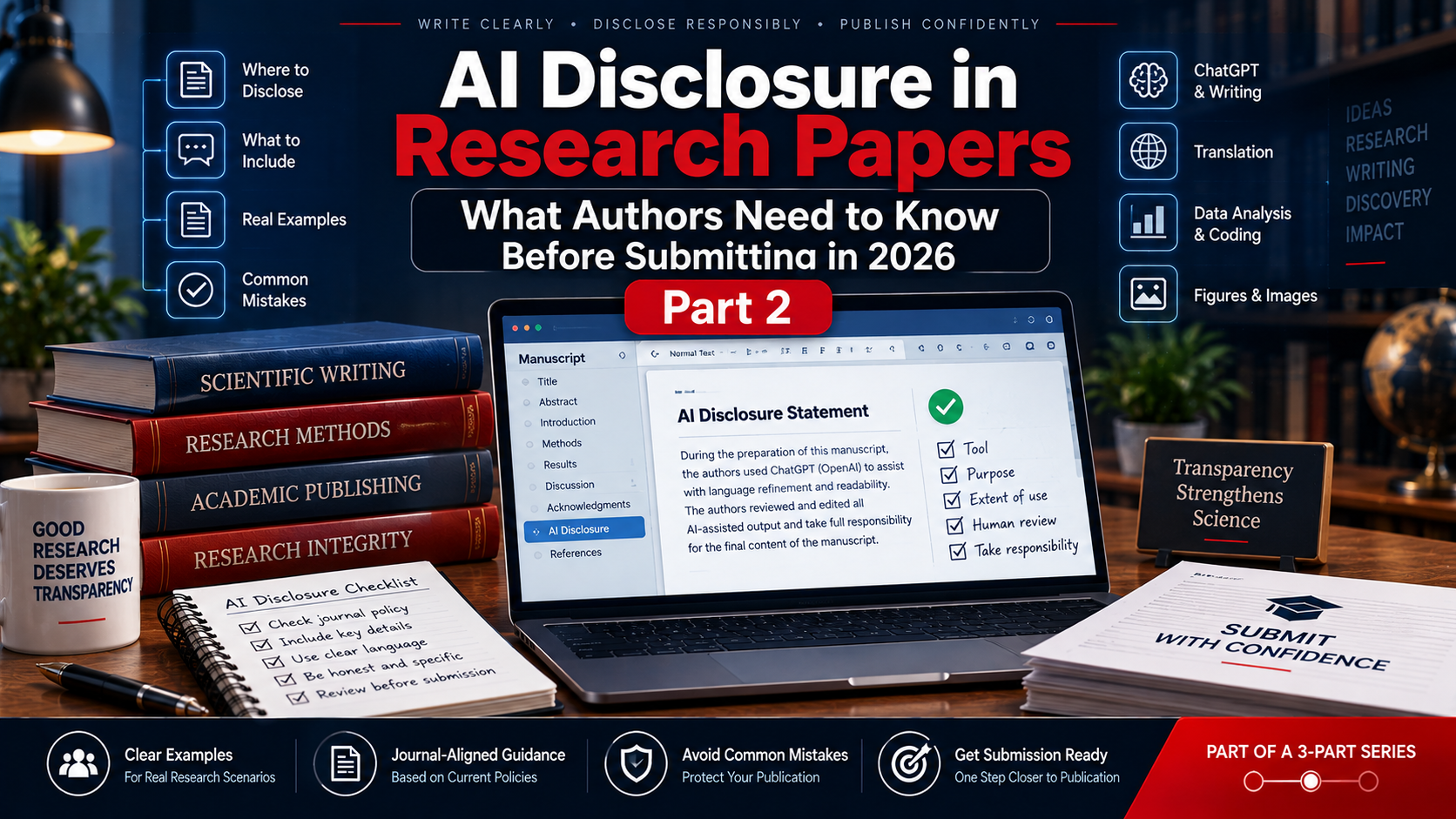
"AI-assisted tools were used for language refinement and manuscript organization. All interpretations, analyses, conclusions, and final content were independently reviewed and approved by the author."
Researchers should adapt disclosure practices according to institutional requirements.
What This Means for the Future of Research
The AI debate is no longer about whether researchers will use AI.
That question has already been answered.
The real question is:
How can researchers use AI responsibly while preserving academic integrity?
Universities worldwide are moving toward a model where:
• AI use is permitted
• AI use is disclosed
• Human accountability remains mandatory
The UGC's revised approach reflects this broader shift.
Final Thoughts
The emergence of AI is transforming academic research, but the core principles of scholarship remain unchanged.
Researchers must still demonstrate:
• Original thinking
• Critical analysis
• Intellectual contribution
• Ethical conduct
AI can accelerate parts of the research process, but it cannot replace the responsibility that comes with producing scholarly work.
For PhD scholars, the safest approach is clear:
Use AI responsibly.
Verify everything.
Disclose appropriately.
Protect your academic integrity.
Frequently Asked Questions
Can AI be used in a PhD thesis under the revised UGC norms?
Yes, but only in a limited and transparent manner.
UGC has clarified that the core content of a PhD thesis must be written by the researcher. AI tools may be used for language correction, grammar improvement, and similar support activities, but researchers remain responsible for the originality and intellectual contribution of their work.
Higher levels of AI-generated or plagiarized content may result in thesis revision, delayed submission, or even cancellation of PhD registration depending on the similarity percentage.
Can ChatGPT be used for grammar correction?
Many institutions permit AI-assisted language support, but researchers should follow their university's specific policies.
Does AI-generated content count as plagiarism?
Undisclosed AI-generated content may be treated as plagiarism if it is presented as entirely original scholarly work.
Will plagiarism software detect AI-generated content?
Not always. AI-generated content may evade traditional plagiarism detection systems, which is one reason disclosure is becoming increasingly important.
Who is responsible for errors in AI-generated content?
The researcher remains fully responsible for all content submitted in a thesis, manuscript, or academic publication.
Sources: TOI (The Times of India article), ugc.gov.in