Can AI Really Help You Publish Faster? What Researchers Should (and Shouldn't) Use AI For in 2026
Artificial Intelligence has rapidly become one of the most talked-about technologies in academic research.
From brainstorming research ideas to improving grammar, summarizing papers, generating code, creating figures, and even drafting manuscripts, AI-powered tools are changing how researchers work. Platforms like ChatGPT, Gemini, Claude, Perplexity, Elicit, SciSpace, Consensus, and many others are now part of the daily workflow of researchers across disciplines.
But with this rapid adoption comes an important question:
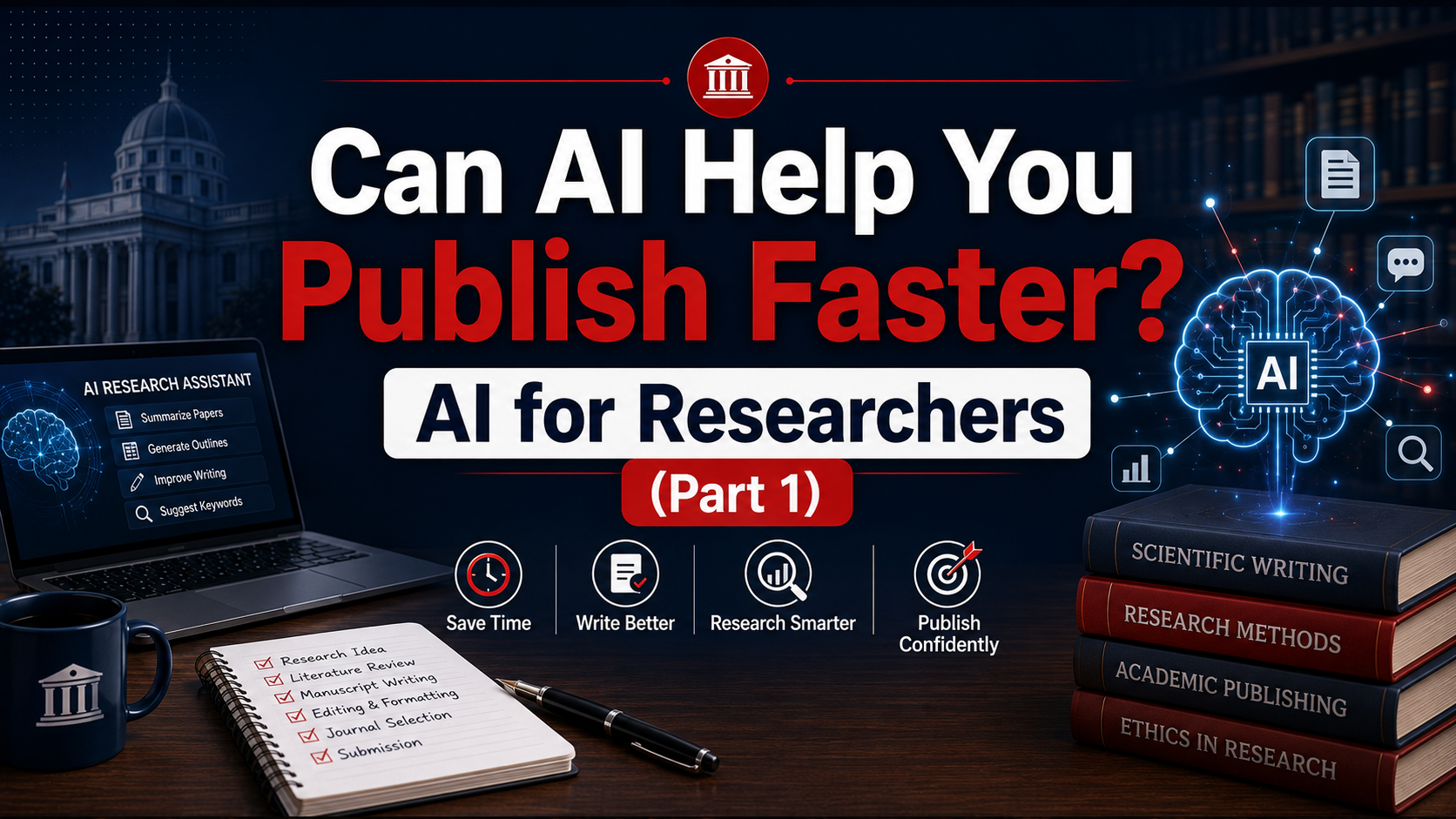
Can AI actually help you publish your research faster?
The answer is yes—but only if you use it correctly.
AI can dramatically reduce the time spent on repetitive and administrative tasks, allowing researchers to focus on what truly matters: designing robust studies, interpreting results, and contributing meaningful scientific knowledge. At the same time, relying too heavily on AI or using it without verification can introduce serious problems, including fabricated references, inaccurate interpretations, ethical concerns, and even manuscript rejection.
Many journals and publishers now allow authors to use AI tools in certain parts of the research and writing process. However, they also make one thing very clear:
Authors—not AI—remain fully responsible for the accuracy, originality, and integrity of their work.
Understanding this distinction is essential.
AI is a research assistant.
It is not a researcher.
It can accelerate your workflow, but it cannot replace scientific thinking, critical analysis, ethical judgment, or subject expertise.
In this guide, we'll explore where AI genuinely helps researchers save time, where it should never replace human expertise, and how you can integrate AI responsibly throughout the publication process without compromising research integrity.
Whether you're preparing your first manuscript or publishing regularly, this article will help you make smarter decisions about using AI in academic research.
Why Researchers Are Turning to AI
Research has never been a simple process.
A single publication often involves:
• Reviewing hundreds of research papers.
• Identifying gaps in existing literature.
• Designing experiments.
• Collecting and analysing data.
• Writing multiple manuscript drafts.
• Formatting references.
• Selecting an appropriate journal.
• Responding to reviewer comments.
• Revising the manuscript.
• Managing submission requirements.
Each stage demands significant time and attention to detail.
As publication expectations continue to increase, researchers are looking for ways to reduce repetitive work without compromising quality.
This is where AI has become particularly valuable.
Rather than replacing researchers, AI automates many routine tasks that previously consumed hours or even days.
Instead of spending an afternoon rewriting awkward paragraphs, researchers can focus on improving scientific arguments.
Instead of manually formatting hundreds of references, AI-assisted tools can automate much of the process.
Instead of reading dozens of papers to identify a common theme, AI can generate concise summaries that help researchers decide which articles deserve deeper reading.
The objective is not to let AI conduct research.
The objective is to allow researchers to spend more time doing research.
The Biggest Misconception About AI in Research
One of the most common misconceptions is that AI can write an entire research paper that is ready for journal submission.
This belief is not only unrealistic but also potentially harmful.
Large language models generate text by predicting likely word sequences based on patterns in the data they were trained on.
They do not:
• Conduct experiments.
• Verify scientific facts.
• Understand your unpublished data.
• Evaluate statistical validity.
• Accept responsibility for conclusions.
Because of this, AI can occasionally produce information that appears convincing but is completely incorrect.
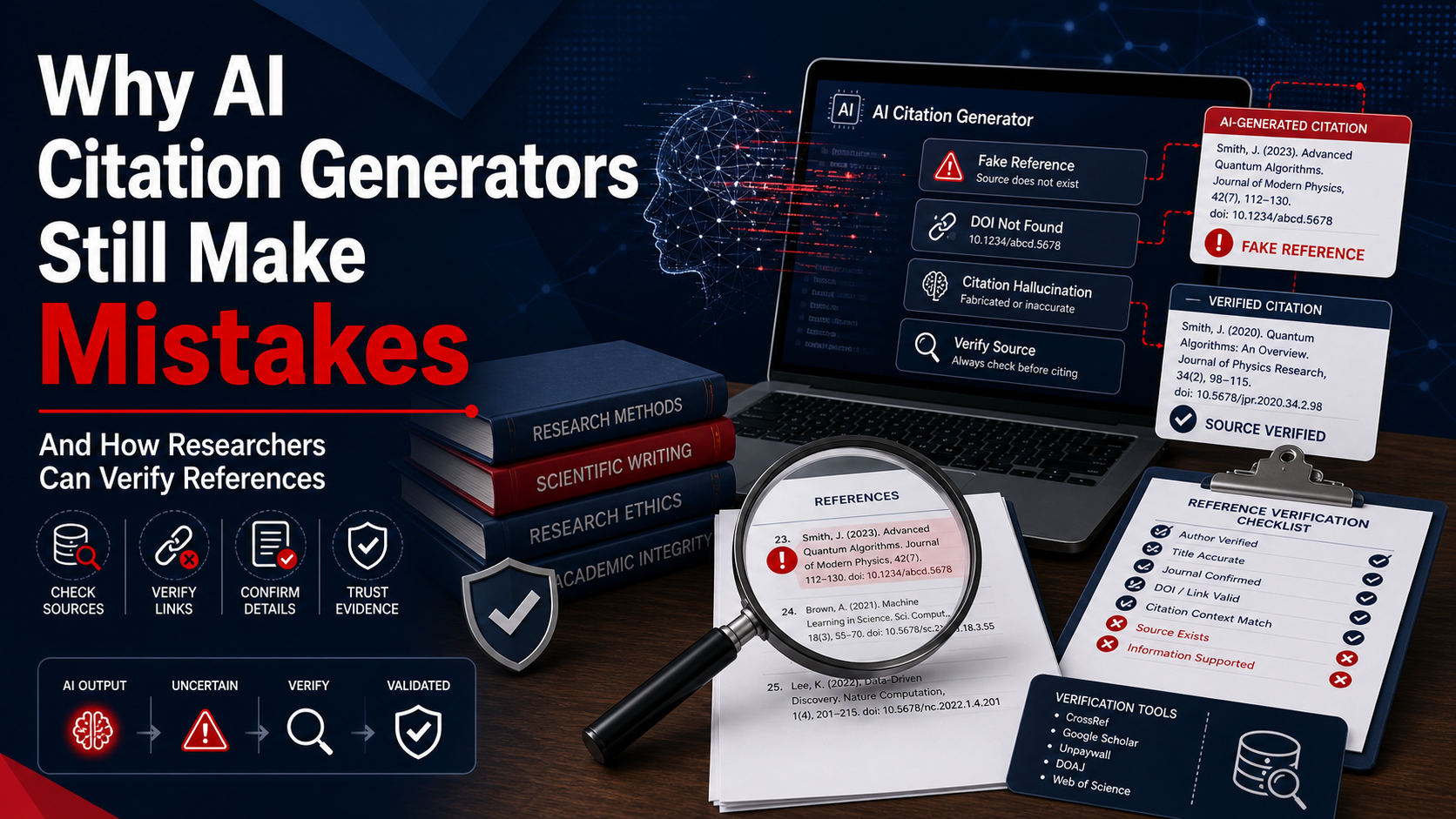
This phenomenon is often referred to as an AI hallucination.
For example, an AI system may confidently generate:
• References that do not exist.
• Incorrect DOIs.
• Misquoted research findings.
• Non-existent journal articles.
• Invented statistical values.
If these errors are not identified before submission, they can damage the credibility of the manuscript and create unnecessary problems during peer review.
Successful researchers therefore use AI as a collaborator for routine tasks—not as an unquestioned source of scientific truth.
Can AI Really Help You Publish Faster?
Yes—but perhaps not in the way many people expect.
AI rarely shortens the scientific part of research.
Experiments still require careful planning.
Data still need to be collected.
Results still need to be analysed.
Scientific discoveries cannot be automated.
Where AI creates significant time savings is in the supporting activities surrounding research.
Consider a typical manuscript preparation process.
Without AI, a researcher might spend hours:
• Rewriting paragraphs for clarity.
• Searching for suitable journal keywords.
• Improving an abstract.
• Drafting a cover letter.
• Summarising long review papers.
• Checking grammar.
• Formatting references.
Many of these activities can now be completed much faster with responsible AI assistance.
The cumulative time savings across an entire publication project can be substantial.
Researchers should therefore think of AI as a productivity tool rather than a scientific replacement.
Where AI Saves the Most Time
One of AI's greatest strengths is reducing repetitive work.
Let's examine the areas where it provides the greatest practical value.
1. Literature Discovery
Finding relevant literature has become increasingly difficult.
Thousands of new scientific papers are published every day across countless disciplines.
Traditional keyword searches often return hundreds or thousands of results.
AI-powered literature discovery tools can help researchers:
• Identify highly relevant papers.
• Discover related publications.
• Compare research themes.
• Find supporting evidence.
• Locate influential review articles.
Instead of replacing database searches, AI helps researchers navigate them more efficiently.
Researchers should still rely on trusted databases such as Web of Science, Scopus, PubMed, IEEE Xplore, or Google Scholar to verify the literature.
2. Summarising Research Papers
Reading scientific literature is essential.
Unfortunately, reading every paper in full is often impossible.
AI can provide concise summaries that highlight:
• Research objectives.
• Methodology.
• Key findings.
• Limitations.
• Future directions.
This allows researchers to prioritise which papers deserve detailed reading.
However, summaries should never replace reading the original paper when the research will directly influence your own study.
AI summaries can occasionally omit important methodological details or oversimplify complex findings.
Think of summaries as a starting point—not the final source of information.
3. Brainstorming Research Ideas
Every research project begins with a question.
AI can be surprisingly useful during this creative stage.
For example, researchers may ask AI to:
• Suggest unexplored research questions.
• Identify emerging trends.
• Compare competing theories.
• Generate possible hypotheses.
• Recommend interdisciplinary connections.
The value lies in stimulating new ideas rather than generating final research questions.
The researcher must still evaluate whether those ideas are scientifically meaningful and practically feasible.
4. Creating an Initial Manuscript Outline
Beginning a manuscript is often more difficult than writing it.
Many researchers experience "blank page syndrome."
AI can quickly generate structured outlines based on standard scientific formats such as IMRaD (Introduction, Methods, Results, and Discussion).
For example, it can suggest:
• Introduction headings.
• Literature review structure.
• Discussion subsections.
• Potential limitations.
• Future research directions.
This provides a useful framework that researchers can customise according to their study.
Importantly, the outline should always reflect the logic of the research—not simply the AI's suggestions.
5. Improving Academic Writing
Clear communication is just as important as strong science.
Many researchers, particularly those writing in English as a second language, spend considerable time refining sentence structure.
AI can help by:
• Simplifying complex sentences.
• Correcting grammar.
• Improving readability.
• Removing repetition.
• Adjusting tone for academic audiences.
This allows researchers to communicate their findings more effectively while preserving the scientific content.
However, every suggested revision should be reviewed carefully.
Sometimes AI changes wording in ways that subtly alter scientific meaning.
Human review remains essential.
6. Writing Better Abstracts
The abstract is often the first—and sometimes only—part of a manuscript that editors and readers examine.
A well-written abstract can significantly improve the chances of attracting reviewers and readers.
AI can assist by:
• Reducing unnecessary words.
• Improving logical flow.
• Enhancing clarity.
• Ensuring key findings are emphasised.
Researchers should remember that the abstract represents their work.
Every statement must accurately reflect the study's objectives, methods, results, and conclusions.
AI should polish—not rewrite—the science.
7. Generating Better Titles
Choosing an effective manuscript title is surprisingly challenging.
A title should be:
• Accurate.
• Specific.
• Searchable.
• Informative.
• Concise.
AI can generate multiple title variations based on your manuscript, helping authors evaluate different styles and identify stronger options.
For example, AI may suggest titles that are:
• More descriptive.
• Better optimised for search engines.
• Easier to understand.
• More attractive to readers.
The final decision should always remain with the researcher.
8. Keyword Optimisation
Many journals ask authors to provide keywords during submission.
Good keywords improve discoverability in academic databases and search engines.
AI can recommend keywords based on:
• Research topic.
• Subject terminology.
• Frequently used scientific phrases.
• Related concepts.
Researchers should still compare AI-generated keywords with those used in recently published papers from their target journal.
9. Language Editing Before Professional Review
Professional editing remains valuable for manuscripts intended for publication.
However, AI can substantially improve the quality of an early draft before it reaches an editor.
Researchers commonly use AI to:
• Remove grammatical errors.
• Improve transitions.
• Increase readability.
• Correct awkward phrasing.
• Ensure consistency.
This often allows professional editors to focus on higher-level improvements such as clarity, scientific flow, argument strength, and publication readiness.
AI Is Most Valuable for Repetitive Tasks
Across all of these examples, a clear pattern emerges.
AI performs best when the task involves:
• Organising information.
• Rewriting text.
• Improving language.
• Summarising documents.
• Generating ideas.
• Automating repetitive formatting.
These activities consume considerable time but generally do not require original scientific discovery.
That is precisely where AI delivers its greatest value.
The researcher, meanwhile, remains responsible for designing experiments, interpreting findings, drawing conclusions, and ensuring the scientific integrity of the work.
In other words:
AI accelerates the publication process by reducing administrative and writing burdens—not by replacing scientific expertise.
Before You Trust AI, Remember This
Every output generated by AI should be treated as a draft, not a final answer.
Before incorporating AI-generated content into your manuscript, always verify:
✓ Scientific facts
✓ References and DOIs
✓ Statistical values
✓ Journal names
✓ Ethical statements
✓ Technical terminology
✓ Numerical data
The fastest way to lose an editor's confidence is to submit a manuscript containing AI-generated inaccuracies that could have been identified with careful review.
Responsible AI use is not about asking better questions alone.
It is about combining AI's efficiency with the researcher's critical thinking, subject knowledge, and commitment to scientific integrity.
In Part 2, we'll examine where AI should never be trusted without human verification, the most common AI mistakes that lead to journal problems, how leading publishers view AI use, and a complete AI-assisted publication workflow that researchers can follow responsibly.