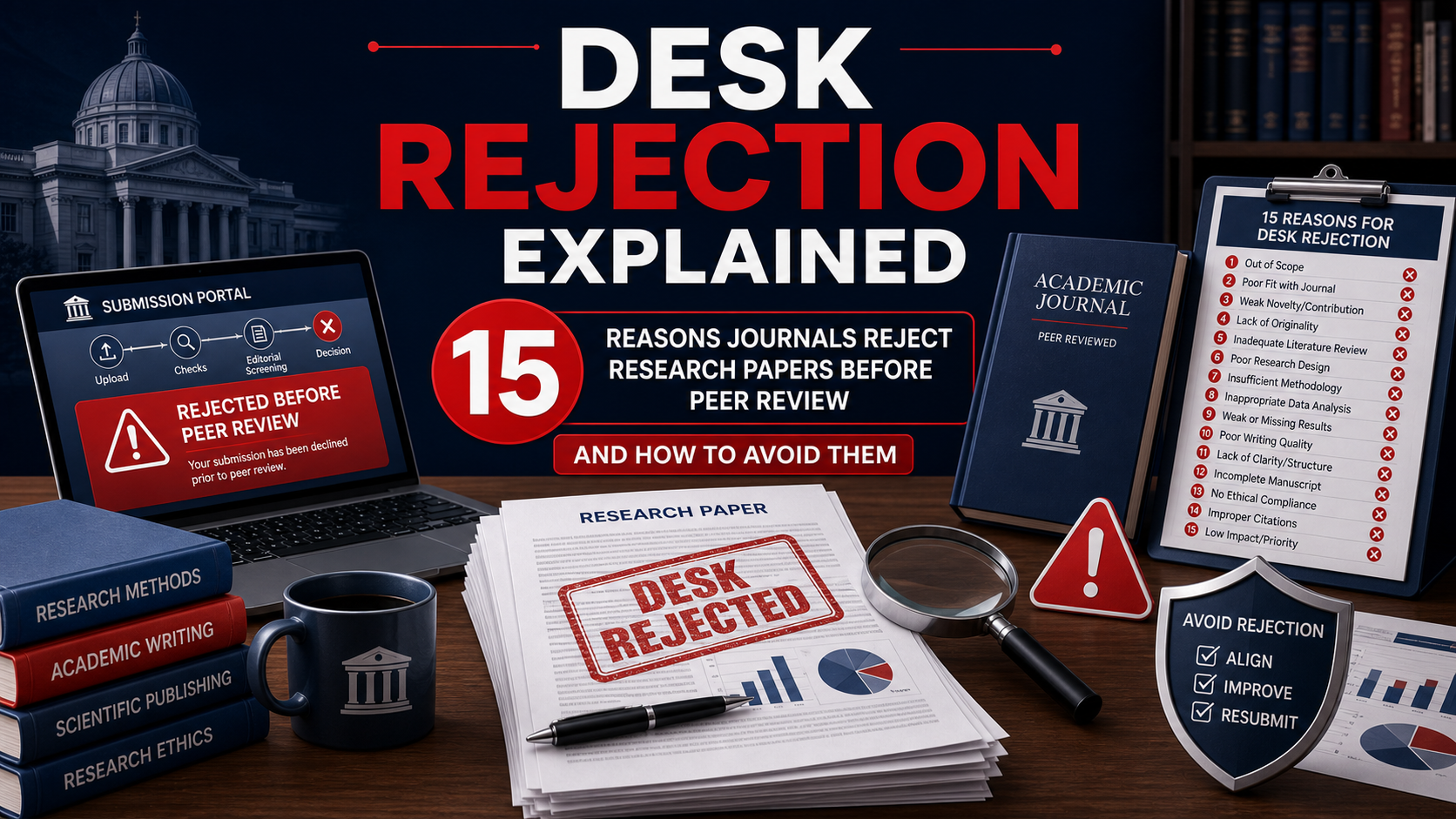
Desk Rejection Explained: 15 Reasons Journals Reject Research Papers Before Peer Review (And How to Avoid Them)
After months—or even years—of conducting experiments, analyzing data, and writing your manuscript, clicking the "Submit" button can feel like crossing the finish line.
Then, only a few days later, an email arrives.
"We regret to inform you that your manuscript will not be considered for publication in our journal..."
No reviewer comments.
No revision requests.
No peer review.
Just a rejection.
If this has happened to you, you're not alone.
Many researchers assume every submitted manuscript is automatically sent to expert reviewers. In reality, a significant proportion of submissions are rejected by journal editors before they ever reach the peer-review stage. Depending on the journal and discipline, desk rejection rates can exceed 50%, and for some highly selective journals they may be considerably higher. The exact rate varies by publisher, journal scope, and editorial policy. Major publishers such as Elsevier and Springer Nature note that an initial editorial screening is a standard part of the publication process.
The encouraging news is that many desk rejections are preventable.
Understanding how editors evaluate submissions can dramatically improve your chances of progressing to peer review.
In this guide, we'll explain:
• What a desk rejection actually means
• Why editors reject manuscripts before peer review
• The 15 most common reasons for desk rejection
• Practical strategies to avoid each one
Whether you're submitting your first manuscript or your fiftieth, understanding the editorial screening process can save valuable time and reduce unnecessary publication delays.
What Is a Desk Rejection?
A desk rejection (also called an editorial rejection or editor rejection) occurs when the journal's editor decides not to send a manuscript for external peer review.
Instead of asking independent reviewers to evaluate the paper, the editor concludes during the initial assessment that the manuscript is unsuitable for the journal.
This decision is usually made shortly after submission.
Depending on the journal, authors may receive a decision within:
• A few days
• One week
• Two weeks
• Occasionally longer for journals receiving exceptionally high submission volumes
Although disappointing, a desk rejection often allows researchers to revise the manuscript quickly and submit it elsewhere without waiting months for peer-review reports.
Desk Rejection vs Peer Review Rejection
Many early-career researchers confuse these two outcomes.
They are fundamentally different.
| Desk Rejection | Peer Review Rejection |
|---|---|
| Decision made by editor | Decision informed by external reviewers |
| No external review | Full peer-review completed |
| Usually occurs within days | Often takes weeks or months |
| Usually focuses on scope, quality, novelty, or policy | Often focuses on scientific validity, methodology, interpretation, or revisions |
Receiving a desk rejection does not necessarily mean your research is poor.
In many cases, it simply means the manuscript is not the right fit for that particular journal.
Why Do Journals Use Desk Rejections?
Researchers sometimes view desk rejections as unfair.
From an editorial perspective, however, they serve several important purposes.
Editors receive far more submissions than they can reasonably send to reviewers.
A preliminary screening helps:
• Reduce reviewer workload
• Speed up editorial decisions
• Maintain journal quality
• Ensure manuscripts match the journal's aims and scope
• Prevent unnecessary delays for authors
Reviewers volunteer significant amounts of their time.
Sending clearly unsuitable manuscripts for review wastes valuable academic resources.
Editorial screening benefits both reviewers and authors.
How Common Are Desk Rejections?
Desk rejection rates vary widely.
General-interest journals and high-impact publications often reject a large proportion of submissions before peer review because they receive thousands of manuscripts every year.
Factors affecting desk rejection rates include:
• Journal prestige
• Submission volume
• Editorial policy
• Research field
• Acceptance rate
For highly selective journals, editorial screening is an essential part of managing submission quality.
Researchers should therefore view desk rejection as a normal aspect of scholarly publishing—not as a personal failure.
What Editors Look for During Initial Screening
Although every journal follows its own editorial process, editors typically ask similar questions during the first review.
For example:
• Does this manuscript fit our journal?
• Is the research original?
• Is the methodology scientifically sound?
• Is the manuscript professionally prepared?
• Will our readers find this work valuable?
Editors often make these assessments surprisingly quickly.
Studies examining editorial workflows suggest that experienced editors can identify major problems within the first few pages of a manuscript.
This highlights the importance of making a strong first impression.
1. Your Research Doesn't Match the Journal's Scope
This is consistently one of the most common reasons for desk rejection.
Even an excellent paper may be rejected immediately if it falls outside the journal's stated aims and scope.
For example:
A manuscript describing pharmaceutical formulation techniques is unlikely to be appropriate for a journal focused exclusively on clinical cardiology.
Similarly, a computational biology study may not fit a journal dedicated to medicinal chemistry.
How to Avoid It
Before submission:
• Read the journal's aims and scope carefully.
• Review at least 10–15 recently published papers.
• Ask yourself:
"Would my manuscript naturally fit alongside these articles?"
If the answer is uncertain, consider another journal.
2. The Research Lacks Sufficient Novelty
Editors routinely ask:
"What is new about this study?"
If the manuscript simply repeats previous work without offering meaningful new insights, editors may decide that peer review is unlikely to change the publication decision.
Novelty does not always require a revolutionary discovery.
It may involve:
• A new methodology
• A new application
• New experimental evidence
• A novel dataset
• A meaningful improvement over existing work
However, the contribution must be clearly explained.
How to Avoid It
State your research gap explicitly.
Readers—and editors—should understand within the introduction:
• What problem exists?
• Why previous work is insufficient?
• What your study contributes?
3. Poor Manuscript Presentation
Editors often see hundreds of manuscripts every month.
Presentation matters.
Common issues include:
• Numerous grammar mistakes
• Poor English
• Formatting inconsistencies
• Unclear figures
• Missing tables
• Inconsistent headings
Even strong science may receive an unfavorable first impression if the manuscript appears rushed or poorly prepared.
How to Avoid It
Before submission:
• Proofread multiple times.
• Ask colleagues to review the manuscript.
• Use professional editing where appropriate.
• Follow the journal's formatting requirements carefully.
Clear writing improves both readability and credibility.
4. The Study Has Obvious Methodological Weaknesses
Editors may identify fundamental methodological concerns before sending the paper for review.
Examples include:
• Inadequate sample size
• Missing controls
• Weak experimental design
• Unsupported conclusions
• Insufficient statistical analysis
If major flaws are immediately apparent, editors may conclude that peer review is unlikely to resolve them.
How to Avoid It
Before submission, critically evaluate:
• Study design
• Statistical methods
• Experimental controls
• Reproducibility
• Reporting transparency
Whenever possible, seek feedback from experienced colleagues before submitting.
5. The Manuscript Fails to Follow Author Guidelines
Surprisingly, many submissions ignore basic instructions provided by the journal.
Examples include:
• Incorrect reference style
• Missing declarations
• Improper manuscript structure
• Word count exceeded
• Missing graphical abstract (when required)
• Incomplete supplementary files
Although these issues may seem minor, they suggest a lack of attention to detail.
How to Avoid It
Use the journal's submission checklist.
Verify every requirement before uploading your files.
A final compliance review can prevent easily avoidable delays.
6. Weak Abstract and Title
Editors often read the title and abstract before anything else.
If these sections fail to communicate the importance of the research, the manuscript begins with a disadvantage.
Common problems include:
• Generic titles
• Vague objectives
• Missing key findings
• Poor structure
• Overly technical language
How to Avoid It
Write your title and abstract after completing the manuscript.
Ask:
"Would someone unfamiliar with my work immediately understand why this research matters?"
Your abstract should clearly present:
• Background
• Objective
• Methods
• Main findings
• Key conclusion
7. The Journal Has Recently Published Similar Work
Editors aim to maintain diversity within each issue.
If your manuscript substantially overlaps with recently published articles—even if scientifically sound—it may not receive priority.
How to Avoid It
Review the journal's recent publications.
Explain clearly how your study differs from existing work published in that journal.
Demonstrating a unique contribution improves editorial interest.
8. Ethical or Compliance Issues
Ethical concerns are taken extremely seriously.
Editors may reject manuscripts immediately if required ethical documentation is missing.
Examples include:
• Missing ethics committee approval
• Missing informed consent statements
• Undisclosed conflicts of interest
• Missing funding disclosures
• Plagiarism concerns
• Image manipulation
• Duplicate submission
Many journals follow guidance from organizations such as the Committee on Publication Ethics (COPE) and the International Committee of Medical Journal Editors (ICMJE) when handling these issues.
How to Avoid It
Before submission, confirm that all required ethical declarations are complete and accurate.
Transparency builds trust with editors and reviewers alike.
9. Weak or Unconvincing Cover Letter
Many researchers underestimate the importance of the cover letter.
Although some journals treat it as optional, many editors read it before deciding whether the manuscript deserves further consideration.
A weak cover letter often:
• Simply repeats the abstract
• Fails to explain why the manuscript fits the journal
• Doesn't highlight novelty
• Ignores the journal's readership
Remember:
The cover letter is your opportunity to explain why this journal should consider your research.
How to Avoid It
A strong cover letter should briefly explain:
• Why the study is important
• What gap it fills
• Why the journal's audience would benefit
• Confirmation that the manuscript is original and not under consideration elsewhere
10. Poor Quality Figures and Tables
Editors frequently judge manuscript quality by its figures.
Common problems include:
• Low-resolution images
• Illegible labels
• Inconsistent formatting
• Missing legends
• Duplicate figures
• Poor colour choices
Even excellent research can appear less credible when presented poorly.
How to Avoid It
Before submission:
• Export figures at the required resolution.
• Ensure all labels remain readable after resizing.
• Keep colours consistent.
• Write informative figure captions.
Remember:
Figures often communicate your findings faster than text.
11. Incomplete or Outdated Literature Review
Editors expect authors to demonstrate awareness of current research.
If the manuscript relies heavily on old references while ignoring recent developments, editors may question whether the study adequately reflects the current state of knowledge.
Common issues include:
• Few recent references
• Missing landmark studies
• Ignoring contradictory evidence
• Over-reliance on self-citations
How to Avoid It
Review literature published within the last three to five years where appropriate.
Discuss how your research builds upon—not simply repeats—existing knowledge.
12. Unsupported or Overstated Conclusions
One of the quickest ways to lose editorial confidence is by making claims that extend beyond the presented evidence.
Examples include:
❌ Claiming clinical effectiveness from laboratory studies.
❌ Generalizing results from a very small sample.
❌ Suggesting worldwide applications based on limited data.
Editors value balanced interpretation.
How to Avoid It
Ensure every conclusion is directly supported by your results.
Clearly acknowledge study limitations.
A cautious discussion often appears more scientifically rigorous than exaggerated claims.
13. Poor Reference Quality
References tell editors a great deal about a manuscript.
Problems include:
• Incorrect citation style
• Missing DOIs
• Broken references
• Excessive self-citations
• References that do not support the stated claims
• AI-generated or fabricated citations
Increasingly, editors encounter manuscripts containing references generated by AI that cannot be verified.
Such errors immediately reduce confidence in the manuscript.
How to Avoid It
Verify every reference manually.
Use trusted databases such as:
• Crossref
• PubMed
• Google Scholar
• Scopus
Reference management software like Zotero, EndNote, or Mendeley can also help maintain citation accuracy.
14. Low Scientific Significance
Not every technically correct study provides sufficient scientific contribution for every journal.
Editors consider questions such as:
• Does this study solve an important problem?
• Will readers learn something new?
• Does it advance the field?
• Will it attract citations?
A manuscript may be scientifically sound yet still be considered unsuitable because its contribution is too limited for that journal.
How to Avoid It
Frame your work within the broader scientific context.
Explain:
• Why the research matters.
• Who benefits.
• How it advances existing knowledge.
15. The Manuscript Appears Rushed
Experienced editors can often recognize when a manuscript has been submitted before it is truly ready.
Signs include:
• Typographical errors
• Placeholder text
• Inconsistent formatting
• Missing sections
• Incorrect figure numbering
• Incomplete supplementary material
These issues create an impression of carelessness.
How to Avoid It
Never submit immediately after finishing the manuscript.
Instead:
• Leave it for a day or two.
• Re-read it with fresh eyes.
• Ask a colleague to review it.
• Perform one final quality check.
The final review often identifies mistakes that were invisible during writing.
The 20-Minute Pre-Submission Audit
Before clicking "Submit," spend twenty minutes reviewing your manuscript using this checklist.
Journal Fit
✅ Scope matches your research.
✅ Recent articles are relevant to your topic.
Scientific Quality
✅ Research question is clearly defined.
✅ Methods are appropriate.
✅ Conclusions match the data.
Writing Quality
✅ Grammar and spelling reviewed.
✅ Title and abstract are compelling.
✅ Figures and tables are publication-ready.
Compliance
✅ Author guidelines followed.
✅ Required declarations included.
✅ Ethics approval documented (if applicable).
✅ Conflict of interest statement completed.
References
✅ All citations verified.
✅ DOIs checked where available.
✅ Citation style matches journal requirements.
Completing this audit can prevent many avoidable desk rejections.
Common Myths About Desk Rejections
Myth 1
"Desk rejection means my research is bad."
Reality:
Many excellent papers are rejected simply because they are submitted to the wrong journal.
Myth 2
"Editors only look at the abstract."
Reality:
Editors often evaluate several components, including:
• Title
• Abstract
• Cover letter
• Figures
• Introduction
• Journal fit
Myth 3
"If I improve the English, my paper will be accepted."
Reality:
Language quality matters, but scientific quality, novelty, methodology, and journal fit remain equally important.
Myth 4
"Submitting to a higher-impact journal first always makes sense."
Reality:
Repeated rejections can delay publication for months.
Choosing the right journal is usually more effective than simply choosing the highest-impact one.
How to Greatly Reduce Your Chances of Desk Rejection
Although no researcher can eliminate rejection entirely, several practices consistently improve editorial outcomes.
Choose the Right Journal
Journal selection should be based on:
• Scope
• Audience
• Editorial standards
• Indexing
—not Impact Factor alone.
Follow Every Author Guideline
Editors notice attention to detail.
Small compliance issues can influence first impressions.
Seek Independent Feedback
Fresh reviewers often identify weaknesses before editors do.
Constructive criticism before submission is far less painful than rejection afterwards.
Verify Every Reference
Accurate citations demonstrate professionalism.
Incorrect or fabricated references undermine credibility.
Never Rush Submission
The final review is often the most valuable step in manuscript preparation.
Patience frequently improves publication success.
Researcher Resource
🚀 FREE RESEARCHER RESOURCE
AI in Research: The Complete Ethical Researcher's Guide (2026 Edition)
Publishing success today requires more than good writing. Learn how to use AI ethically for literature reviews, manuscript preparation, reference verification, prompt engineering, disclosure requirements, and responsible research workflows.
Key Takeaways
✅ A desk rejection occurs before peer review and is usually based on editorial assessment.
✅ Many desk rejections are preventable through better journal selection and manuscript preparation.
✅ Scope mismatch, lack of novelty, poor presentation, and ethical issues remain among the most common causes.
✅ A thorough pre-submission review significantly improves your chances of progressing to peer review.
✅ Rejection is a normal part of academic publishing and often provides an opportunity to improve and reposition your work.
Final Thoughts
Receiving a desk rejection can be discouraging, but it should not be viewed as the end of your publication journey.
Editors must make difficult decisions while balancing journal scope, editorial priorities, reviewer availability, and scientific quality. In many cases, a desk rejection reflects a mismatch between the manuscript and the journal—not a lack of value in the research itself.
The most successful researchers rarely avoid rejection altogether. Instead, they learn from editorial decisions, refine their manuscripts, and adopt a strategic approach to journal selection and submission.
At Beubenz Scientific Writing Services (BSWS), we believe many desk rejections can be prevented through careful manuscript preparation, appropriate journal selection, accurate reference verification, and adherence to ethical publishing standards. Our educational resources are designed to help researchers navigate these challenges with confidence and improve their chances of successful publication.
Frequently Asked Questions
What is a desk rejection?
A desk rejection is an editorial decision to reject a manuscript before sending it for external peer review because it is considered unsuitable for the journal.
How long does a desk rejection usually take?
Many journals issue desk rejection decisions within a few days to two weeks, although timelines vary depending on editorial workload.
Does a desk rejection mean my research is poor?
No. Many desk rejections result from journal scope mismatch, editorial priorities, or presentation issues rather than poor scientific quality.
Can I submit the same manuscript to another journal after a desk rejection?
Yes. Since the manuscript was not peer reviewed, authors can revise it if necessary and submit it to another suitable journal, provided it is no longer under consideration elsewhere.
What is the biggest cause of desk rejection?
One of the most common reasons is submitting a manuscript that falls outside the journal's aims and scope. Other frequent causes include insufficient novelty, poor manuscript preparation, and failure to follow author guidelines.
Source Verification
This article is based on information obtained from:
• Official author guidance from Elsevier, Springer Nature, Wiley, Taylor & Francis, IEEE, and other scholarly publishers.
• Committee on Publication Ethics (COPE) resources on editorial processes and publication ethics.
• International Committee of Medical Journal Editors (ICMJE) recommendations where applicable.
• Official journal author guidelines and editorial best practices from leading academic publishers.
Verification Status
The editorial practices, examples, and recommendations described in this article were verified against official publisher guidance and recognized publication ethics resources. Individual journals may have additional submission requirements or editorial policies that authors should review before submission.
Last Verified
7 July 2026