Scopus Update: 25 Journals Discontinued in May 2026
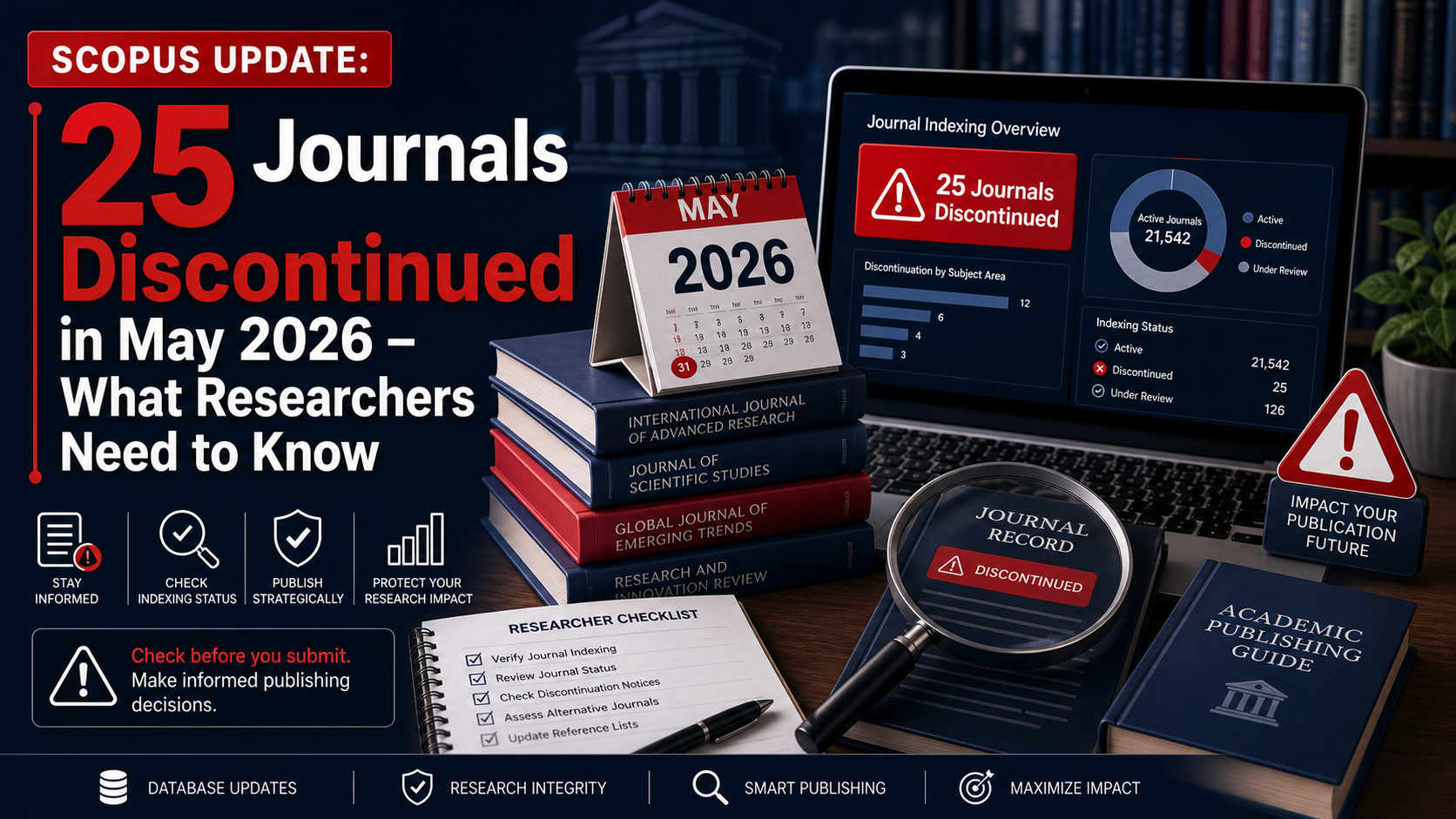
Scopus has released its latest source evaluation update, and 25 journals have been discontinued from Scopus coverage in May 2026.
For researchers, PhD scholars, faculty members, and academic authors, this serves as an important reminder that journal indexing status can change over time. Verifying a journal's current indexing status before manuscript submission is an essential part of responsible publication planning.
This article explains what the latest discontinuation update means, why journals may be removed from Scopus coverage, and how researchers can protect themselves from submitting to journals that no longer meet indexing standards.
What Happened in May 2026?
According to the latest Scopus source evaluation update, 25 journals were discontinued from Scopus indexing coverage during May 2026.
These journals span multiple disciplines, including:
• Social Sciences
• Arts and Humanities
• Management
• Education
• Computing
• Health Sciences
• Interdisciplinary Research
While the affected journals may continue to publish articles, they are no longer actively covered by Scopus from the discontinuation date onward.
What Does "Discontinued by Scopus" Mean?
Many researchers misunderstand discontinuation.
A journal being discontinued by Scopus does not necessarily mean that the journal has ceased operations.
Instead, it means that Scopus has decided to stop indexing newly published content from that source after a particular date.
The journal may:
• Continue accepting submissions
• Continue publishing articles
• Maintain its website and editorial processes
However, future content may no longer be indexed within the Scopus database.
This distinction is important for researchers whose institutions, funding agencies, or academic regulations require publication in currently indexed journals.
Why Does Scopus Discontinue Journals?
Scopus continuously evaluates journals included in its database.
Journals may be discontinued when concerns are identified regarding quality, publishing practices, or indexing standards.
One of the most frequently cited reasons is:
Outlier Behaviour
Outlier Behaviour refers to unusual patterns that raise concerns during indexing evaluations.
These patterns may relate to:
• Citation irregularities
• Publishing anomalies
• Editorial concerns
• Quality control issues
• Deviations from expected publishing standards
When significant concerns are identified, Scopus may discontinue coverage while maintaining transparency through publicly available discontinuation lists.
Why Researchers Should Pay Attention
Publishing in an appropriate journal is one of the most important decisions in the research lifecycle.
Submitting to a journal that has recently lost indexing coverage may create challenges related to:
• Academic evaluation requirements
• Promotion criteria
• Funding agency expectations
• Institutional publication policies
• Research visibility
Before submission, researchers should verify whether a journal remains actively indexed rather than relying on outdated information.
How to Verify Journal Indexing Status
Before submitting your manuscript:
1. Verify Through Official Sources
Always check indexing claims directly through official databases rather than relying solely on information displayed on journal websites.
2. Review the Journal's Current Coverage Status
A journal may have been indexed previously but may no longer be actively covered.
Always verify the latest status.
3. Check Recent Scopus Updates
Scopus publishes periodic source evaluation updates and discontinuation information.
Regular monitoring helps researchers make informed publication decisions.
4. Confirm Institutional Requirements
Some universities and funding agencies have specific publication requirements.
Verify that your chosen journal satisfies those requirements before submission.
Common Misconceptions About Discontinued Journals
Myth 1: A Discontinued Journal Is Automatically Predatory
Not necessarily.
Discontinuation and predatory publishing are separate issues.
A journal may be discontinued for various reasons and may continue operating.
Myth 2: Previously Indexed Articles Disappear
Generally, articles indexed before discontinuation remain available in the database.
Discontinuation typically affects future coverage.
Myth 3: Journal Websites Always Display Current Status
Not always.
Researchers should independently verify indexing claims using official sources.
What Researchers Should Do Next
If you are planning a manuscript submission:
✅ Verify indexing status
✅ Review journal scope carefully
✅ Check recent source evaluation updates
✅ Confirm institutional publication requirements
✅ Maintain a shortlist of alternative journals
A few minutes of verification can prevent months of publication-related complications.
Why Journal Verification Is Becoming More Important
The scholarly publishing landscape continues to evolve.
Indexing databases regularly review journals to maintain quality standards and database integrity.
As a result, researchers can no longer assume that a journal's indexing status remains unchanged indefinitely.
Routine journal verification should become part of every researcher's publication workflow.
Final Thoughts
The May 2026 Scopus discontinuation update highlights the importance of informed journal selection.
While a discontinued journal may continue operating, researchers should understand the implications of publishing in sources that are no longer actively covered by major indexing databases.
Before submitting your next manuscript, take the time to verify:
• Indexing status
• Journal quality
• Publisher credibility
• Institutional requirements
Strong research deserves a publication strategy that is equally strong.
Frequently Asked Questions
How many journals were discontinued by Scopus in May 2026?
According to the May 2026 source evaluation update, 25 journals were discontinued from Scopus coverage.
Does discontinuation mean a journal has stopped publishing?
No. Many discontinued journals continue operating and accepting submissions.
What is Outlier Behaviour in Scopus evaluations?
Outlier Behaviour refers to unusual patterns or concerns identified during Scopus source evaluations that may trigger discontinuation decisions.
Should researchers still submit to discontinued journals?
Researchers should carefully evaluate their institutional requirements, publication goals, and indexing expectations before submitting to any discontinued source.
How often does Scopus update its discontinued sources list?
Scopus periodically reviews indexed journals and publishes updates when journals are added to or removed from coverage.