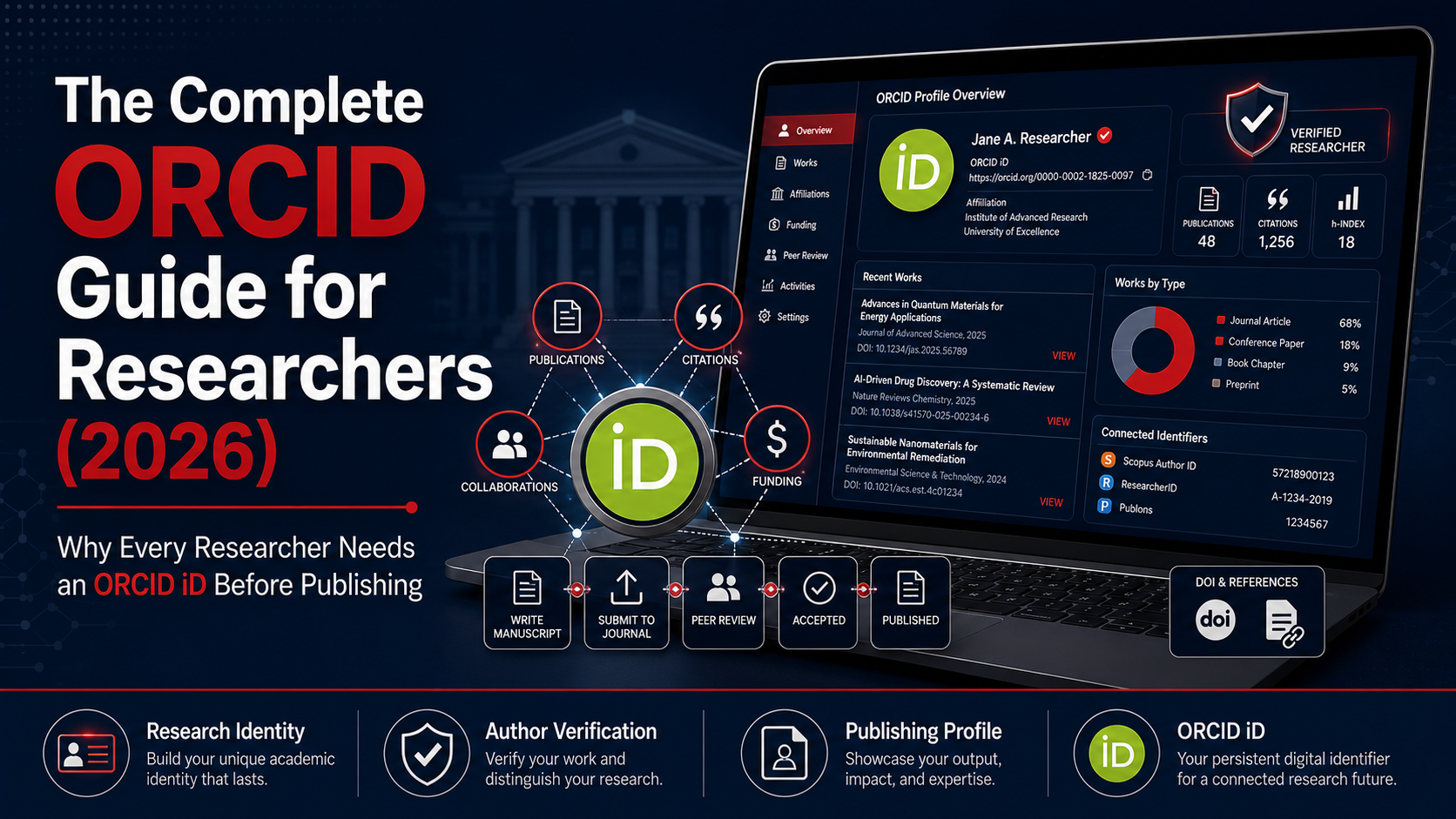
The Complete ORCID Guide for Researchers (2026): Why Every Researcher Needs an ORCID iD Before Publishing
If you've submitted a manuscript to a journal recently, you've almost certainly encountered a request for your ORCID iD.
Many researchers simply create one because the submission system requires it.
But very few understand why ORCID exists, how it benefits their research career, or why publishers, universities, funding agencies, and research institutions around the world increasingly consider it an essential part of scholarly publishing.
An ORCID iD is far more than another online profile.
It is your permanent academic identity.
Whether you're a Master's student preparing your first paper, a PhD scholar building your publication record, or an experienced researcher managing hundreds of publications, an ORCID iD helps ensure that your work is correctly attributed to you throughout your career.
In this guide, we'll explain everything researchers need to know about ORCID, including how it works, why it matters, common misconceptions, and best practices for maintaining a professional research identity.
What Is ORCID?
ORCID stands for Open Researcher and Contributor ID.
It is a non-profit global organization that provides researchers with a unique digital identifier known as an ORCID iD.
An ORCID iD consists of a permanent 16-digit identifier, for example:
Unlike an email address or institutional profile, your ORCID iD remains with you throughout your academic career, regardless of:
• Changing universities
• Moving to another country
• Switching research fields
• Changing your surname
• Working in academia or industry
Your ORCID iD becomes your permanent scholarly identity.
Why Was ORCID Created?
One of the biggest challenges in scholarly publishing has always been author identification.
Thousands of researchers share similar—or even identical—names.
Consider names like:
• Amit Kumar
• Wei Zhang
• Maria Garcia
• John Smith
Without a unique identifier, it becomes difficult to determine:
• Which publications belong to which researcher
• Who authored a particular paper
• Which grants belong to which investigator
• How publication metrics should be calculated
Researchers may also:
• Change institutions
• Publish under different name formats
• Change surnames after marriage
• Use initials inconsistently
These issues create confusion across databases and reduce the accuracy of scholarly records.
ORCID was developed to solve this problem by assigning each researcher a globally unique identifier.
Why ORCID Matters More Than Ever in 2026
Research has become increasingly international.
Today, a single paper may include:
• Researchers from five countries
• Multiple universities
• Industry collaborators
• Government laboratories
• International funding agencies
At the same time, scholarly databases have expanded dramatically.
Your publications may appear in:
• Crossref
• Scopus
• Web of Science
• PubMed
• Europe PMC
• Institutional repositories
• Publisher websites
• University profiles
Without a persistent identifier, maintaining an accurate publication record becomes increasingly difficult.
An ORCID iD acts as the common link connecting all these systems.
How ORCID Works
Every researcher receives one permanent identifier.
Instead of relying only on your name, publishers and databases use your ORCID iD to identify you.
When integrated properly, your ORCID record can automatically connect with:
• Journal submissions
• Published articles
• Peer-review activities
• Grants
• Datasets
• Conference proceedings
• Books
• Research affiliations
Over time, your ORCID profile evolves into a verified record of your scholarly contributions.
Is ORCID Mandatory?
Technically, no.
However, many publishers, journals, and funding organizations strongly encourage—or even require—authors to provide an ORCID iD during submission.
Examples include major publishers such as:
• Elsevier
• Springer Nature
• Wiley
• Taylor & Francis
• IEEE
• PLOS
• Frontiers
Many universities also encourage doctoral researchers to register for ORCID early in their academic careers.
The trend is clear:
ORCID is rapidly becoming a standard part of scholarly publishing.
Benefits of Having an ORCID iD
Creating an ORCID account takes only a few minutes, yet it provides long-term benefits throughout your research career.
1. Eliminates Author Name Confusion
This is perhaps the biggest advantage.
Suppose there are hundreds of researchers named "Amit Kumar."
Your ORCID iD ensures that your publications are correctly attributed to you, regardless of how common your name may be.
2. Builds a Permanent Research Identity
Unlike university profiles that disappear when you graduate or change institutions, your ORCID record remains with you throughout your career.
Your academic identity becomes independent of any single employer.
3. Increases Research Visibility
Many publishers, repositories, and indexing services display ORCID information alongside published articles.
This makes it easier for:
• Editors
• Reviewers
• Collaborators
• Funding agencies
• Other researchers
to discover your work.
Greater visibility can lead to increased collaboration opportunities.
4. Simplifies Journal Submission
Many journal submission systems automatically retrieve information from your ORCID account.
Instead of repeatedly entering:
• Name
• Affiliation
• Previous publications
• Employment history
much of this information can be imported directly.
This saves time and reduces administrative work.
5. Improves Grant Applications
Funding agencies increasingly integrate ORCID into their application systems.
Applicants with an up-to-date ORCID record often spend less time manually entering publication histories.
6. Supports Research Integrity
Because ORCID links scholarly work to verified researchers, it contributes to transparency and accountability in research.
Publishers can more easily identify:
• Authors
• Reviewers
• Editors
• Contributors
This strengthens trust across the research ecosystem.
ORCID vs Google Scholar vs Scopus Author ID vs ResearcherID
One of the most common misconceptions is that these platforms are interchangeable.
They are not.
Each serves a different purpose.
| Platform | Primary Purpose |
|---|---|
| ORCID | Permanent researcher identity |
| Google Scholar Profile | Citation tracking and publication visibility |
| Scopus Author ID | Publication indexing within Scopus |
| Web of Science ResearcherID | Research metrics and indexing within Web of Science |
Think of ORCID as the foundation.
The other systems can often connect to your ORCID profile, creating a more complete scholarly record.
What Information Can Be Added to an ORCID Profile?
An ORCID record can include much more than publications.
Researchers can add:
Employment History
Current and previous institutions.
Education
Degrees and universities attended.
Publications
Journal articles
Books
Book chapters
Conference papers
Preprints
Grants
Research funding received.
Peer Review Activities
Many publishers now allow reviewers to receive verified recognition through ORCID.
Awards
Research awards and academic honors.
Professional Memberships
Scientific societies and organizations.
Websites
Personal websites
Institutional profiles
Laboratory pages
Professional social media
Common Myths About ORCID
Several misconceptions discourage researchers from using ORCID effectively.
Let's address the most common ones.
Myth 1
"I already have Google Scholar."
Reality:
Google Scholar tracks citations.
ORCID verifies identity.
They complement each other.
Myth 2
"I only need ORCID after publishing."
Reality:
Creating an ORCID iD early helps establish a consistent scholarly identity before your publication record grows.
Many graduate schools now encourage registration during postgraduate studies.
Myth 3
"Only senior researchers need ORCID."
Reality:
Early-career researchers often benefit the most because ORCID helps build a professional research identity from the beginning.
Myth 4
"ORCID improves citation counts."
Reality:
ORCID itself does not increase citations.
However, improved discoverability and accurate attribution may make your work easier for others to find.
Common Mistakes Researchers Make
Many researchers register for ORCID but never use it effectively.
Some common mistakes include:
❌ Creating an account and abandoning it.
❌ Leaving employment information incomplete.
❌ Not linking publications.
❌ Using multiple ORCID accounts.
❌ Keeping outdated affiliations.
❌ Ignoring privacy settings.
An incomplete ORCID profile provides far less value than a well-maintained one.
Best Practices for Maintaining Your ORCID Profile
To maximize the benefits of ORCID:
✅ Use your ORCID iD consistently when submitting manuscripts.
✅ Connect your ORCID with publishers whenever possible.
✅ Keep your institutional affiliation updated.
✅ Review your publication list periodically.
✅ Link grants, datasets, and peer-review activities when supported.
Treat your ORCID profile as your academic CV—not a one-time registration.
How to Create an ORCID iD (Step-by-Step)
Creating an ORCID iD is free and typically takes less than five minutes.
Step 1
Visit the official ORCID website:
Always register directly through the official ORCID website rather than third-party services.
Step 2
Enter:
• Full name
• Email address
• Password
Using a permanent personal email is recommended in addition to your institutional email.
Step 3
Verify your email address.
Email verification improves account security and enables integration with publishers and institutions.
Step 4
Choose your visibility settings.
ORCID allows you to decide who can view your information.
You can change these settings at any time.
Step 5
Complete your profile.
Although optional, researchers should immediately add:
• Institution
• Education
• Research interests
• Keywords
• Biography (optional)
An incomplete profile provides significantly less value than a complete one.
Connecting ORCID With Other Research Platforms
One of ORCID's biggest strengths is interoperability.
Instead of maintaining multiple disconnected profiles, ORCID can connect with many scholarly systems.
Crossref
Crossref enables publishers to update your ORCID record automatically after publication.
This helps ensure your publication list remains current.
Scopus
Researchers can link their Scopus Author ID with ORCID.
Benefits include:
• Publication synchronization
• Improved author identification
• Better indexing consistency
Web of Science
Researchers using Web of Science can connect their ResearcherID with ORCID.
This improves:
• Publication tracking
• Citation analysis
• Author identity management
Institutional Systems
Many universities now integrate ORCID into:
• Faculty profiles
• Institutional repositories
• Graduate student systems
• Research management platforms
Using these integrations reduces duplicate data entry and improves record accuracy.
Understanding ORCID Privacy Settings
One reason researchers appreciate ORCID is the ability to control profile visibility.
Each item can be assigned one of three visibility levels:
Public
Visible to everyone.
Recommended for:
• Publications
• Employment
• Education
• Professional activities
Trusted Parties
Visible only to organizations you authorize.
Useful when sharing information with publishers or funding agencies.
Private
Visible only to you.
Researchers can choose different visibility settings for different profile sections.
Should You Make Your ORCID Profile Public?
In most cases, yes.
A public profile makes it easier for:
• Editors
• Collaborators
• Conference organizers
• Funding agencies
• Potential research partners
to verify your academic background.
However, researchers should review privacy settings carefully before publishing personal information.
ORCID and Journal Submission
Today, many manuscript submission systems include an ORCID field during author registration.
Providing your ORCID iD can:
• Improve author identification
• Reduce administrative errors
• Enable automatic metadata updates
• Simplify future submissions
Some publishers also display ORCID icons directly alongside published articles, helping readers identify authors more accurately.
ORCID and Research Funding
Funding organizations increasingly use persistent researcher identifiers.
An ORCID profile helps applicants maintain a verified publication history across multiple funding applications.
Rather than manually entering publication details repeatedly, researchers can often reuse information already linked to their ORCID record.
ORCID and Peer Review Recognition
Peer review is an important scholarly contribution.
Historically, reviewers received little formal recognition.
Today, several publishers and peer-review platforms allow researchers to record verified review activities within ORCID.
This enables researchers to demonstrate contributions beyond publishing papers alone.
How Often Should You Update ORCID?
Treat your ORCID profile as a living professional record.
Update it whenever you:
• Publish a paper
• Receive a grant
• Change institutions
• Complete a degree
• Present at a conference
• Receive an award
Regular updates ensure your scholarly record remains accurate.
ORCID Best Practices Checklist
Before submitting your next manuscript, confirm that:
✅ Your ORCID email has been verified.
✅ Your employment information is current.
✅ Your education history is complete.
✅ Your latest publications appear correctly.
✅ Your ORCID is linked to your publisher accounts.
✅ Your Scopus Author ID is connected (if applicable).
✅ Your Web of Science ResearcherID is linked (if applicable).
✅ Your public profile accurately reflects your research interests.
Completing these steps helps create a stronger professional research identity.
Researcher Resource
🚀 FREE RESEARCHER RESOURCE
AI in Research: The Complete Ethical Researcher's Guide (2026 Edition)
Master ethical AI use across literature reviews, manuscript writing, reference verification, disclosure requirements, prompt engineering, and responsible AI workflows.
Whether you're just beginning your research journey or already publishing regularly, this guide will help you use AI confidently while maintaining academic integrity.
Key Takeaways
✅ ORCID provides every researcher with a permanent digital scholarly identity.
✅ An ORCID iD remains with you throughout your career, regardless of institution or country.
✅ Publishers, funding agencies, and universities increasingly integrate ORCID into their workflows.
✅ ORCID improves author identification, discoverability, and publication management.
✅ Keeping your ORCID profile updated strengthens your professional academic presence.
Final Thoughts
Research today extends far beyond writing and publishing papers.
Building a trusted scholarly identity is equally important.
An ORCID iD helps ensure your work is accurately attributed, easily discoverable, and connected across the global research ecosystem.
Creating an ORCID profile takes only a few minutes, but maintaining it can benefit your academic career for decades.
At Beubenz Scientific Writing Services (BSWS), we encourage every researcher to think beyond publication alone. A successful research career also depends on accurate author identification, responsible AI use, ethical publishing practices, proper journal selection, and well-prepared manuscripts. Our goal is to help researchers navigate each of these stages with practical resources and evidence-based guidance.
Frequently Asked Questions
Is ORCID free?
Yes. ORCID registration and maintaining an ORCID iD are completely free for researchers.
Can I have more than one ORCID iD?
No. Researchers should maintain only one ORCID iD throughout their career. If duplicate accounts exist, ORCID provides a process to merge them.
Does ORCID replace Google Scholar?
No. ORCID identifies researchers, while Google Scholar primarily tracks publications and citations. They serve complementary purposes.
Can ORCID automatically update my publications?
Yes, when connected with participating publishers and trusted organizations, ORCID can automatically receive updates for new publications.
Is ORCID required for journal submission?
Not universally, but many journals and publishers now strongly encourage or require authors to provide an ORCID iD during submission.
Does ORCID increase citation counts?
No. ORCID does not directly increase citations, but it improves author identification and discoverability, making it easier for others to find your work.
Source Verification
This article is based on information obtained from:
• Official ORCID documentation and help center
• Crossref documentation
• Scopus Author Identifier guidance
• Clarivate Web of Science ResearcherID documentation
• Official publisher guidance from Elsevier, Springer Nature, Wiley, Taylor & Francis, IEEE, and PLOS regarding ORCID integration
Verification Status
All factual claims regarding ORCID registration, functionality, integrations, publisher adoption, and researcher benefits were verified using official documentation available at the time of writing.
Last Verified
2 July 2026