Building Momentum: A 7-Day Research Sprint System for Consistent Progress
One of the biggest misconceptions in academia is that productive researchers are always motivated.
In reality, successful researchers often experience the same challenges as everyone else:
• Procrastination
• Self-doubt
• Information overload
• Writing resistance
• Time constraints
The difference is not motivation.
The difference is systems.
Researchers who make steady progress rarely rely on inspiration. Instead, they create repeatable workflows that move projects forward even on difficult days.
One of the most effective approaches is the 7-Day Research Sprint System.
This simple framework helps researchers build momentum through small, focused actions that compound over time.
Why Momentum Matters More Than Motivation
Motivation is unpredictable.
Some days you feel energized and productive.
Other days opening a manuscript feels impossible.
If your research progress depends entirely on motivation, your output becomes inconsistent.
Momentum works differently.
Small wins create confidence.
Confidence encourages action.
Action generates progress.
Progress creates even more momentum.
This positive cycle is often what separates productive researchers from those who remain stuck.
The Problem with Marathon Research Sessions
Many researchers believe they need large blocks of uninterrupted time to make meaningful progress.
As a result, they postpone work until:
• The weekend
• A holiday
• Semester breaks
• "When things calm down"
Unfortunately, those perfect conditions rarely arrive.
A focused one-hour session repeated consistently often produces better results than occasional ten-hour work marathons.
Consistency beats intensity.
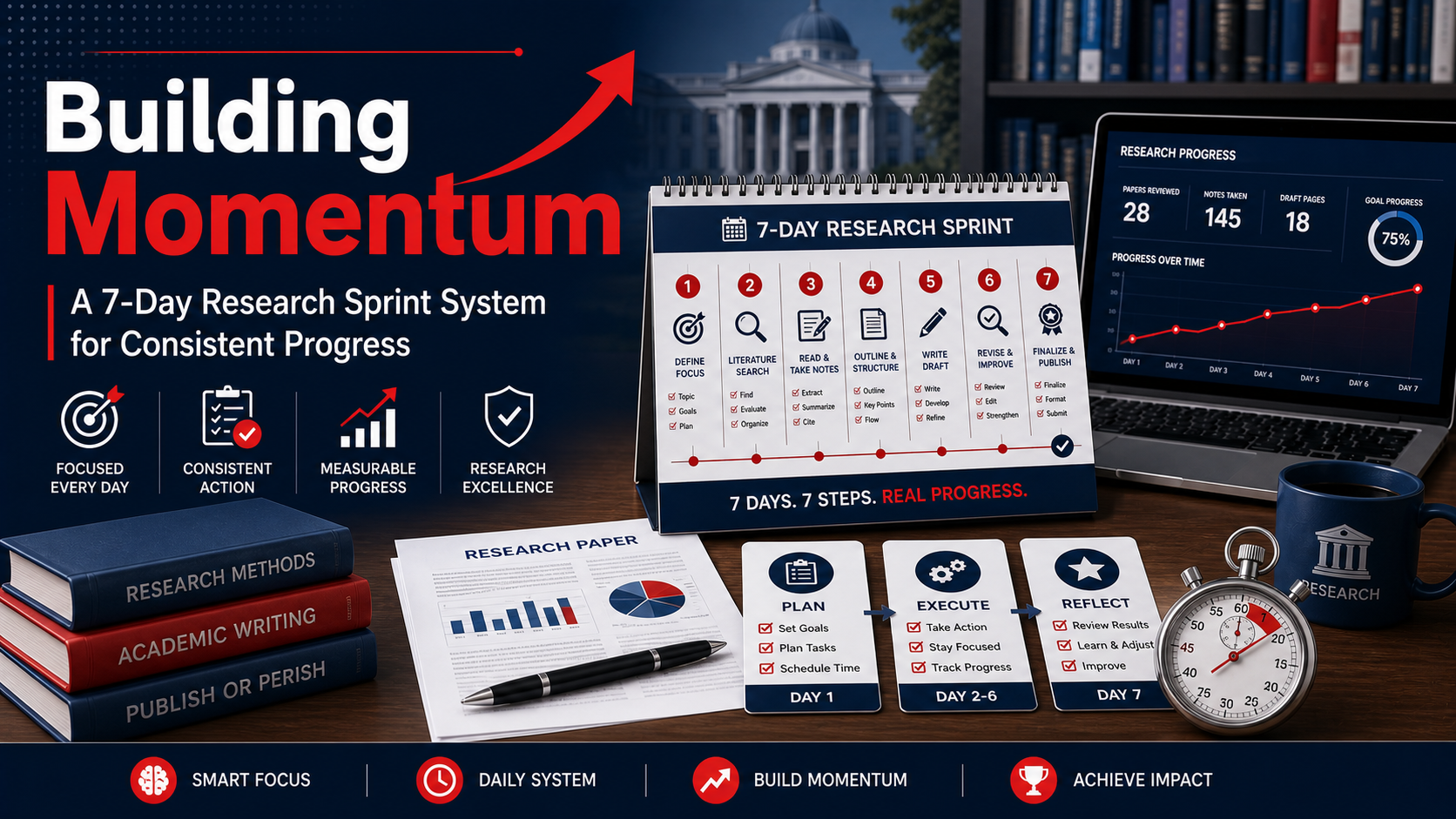
The 7-Day Research Sprint System
The goal is simple:
Commit to one focused hour each day for seven consecutive days.
Each day serves a specific purpose.
Together, the seven days create a complete research cycle.
Day 1: Strategic Literature Review
Begin by consuming information selectively.
Instead of attempting to read entire papers, focus on:
• Abstract
• Introduction
• Methodology
• Conclusion
Select three high-quality papers directly related to your topic.
Document:
• Main findings
• Research gaps
• Useful references
• Potential citations
Outcome
A stronger understanding of the current literature without information overload.
Day 2: Build the Structure
Before writing, create clarity.
Choose the section you plan to work on and build a framework.
Examples:
• Introduction
• Literature Review
• Methodology
• Results
Create:
• Subheadings
• Key arguments
• Supporting references
• Discussion points
Outcome
A clear roadmap that eliminates the fear of the blank page.
Day 3: Write Without Editing
This is where many researchers get stuck.
They attempt to write and edit simultaneously.
Instead:
Write freely.
Ignore:
• Grammar
• Formatting
• Perfection
• Word choice
Focus exclusively on transferring ideas to the page.
Outcome
A complete first draft that can be improved later.
Day 4: Organize Data and Visual Elements
Research is not just text.
Use this day to review:
• Figures
• Tables
• Graphs
• Statistical outputs
• Experimental images
Ensure:
• Labels are clear
• Captions are complete
• Formatting is consistent
Outcome
Stronger visual communication and improved manuscript quality.
Day 5: Revision and Refinement
Now return to the draft created earlier.
Review:
• Logical flow
• Argument structure
• Clarity
• Redundancies
• Formatting consistency
Ask:
Does this section communicate exactly what I intend?
Outcome
A significantly stronger version of your manuscript.
Day 6: External Feedback
Fresh perspectives identify weaknesses we often overlook.
Share your work with:
• Supervisor
• Co-author
• Research colleague
• Peer reviewer
Request honest and specific feedback.
Focus on:
• Clarity
• Structure
• Missing information
• Potential reviewer concerns
Outcome
Actionable insights that improve manuscript quality.
Day 7: Consolidation and Planning
The final day is dedicated to reflection and preparation.
Review:
• What was completed?
• What remains unfinished?
• Which challenges emerged?
Set objectives for the next sprint.
Examples:
• Complete literature review
• Draft methodology section
• Prepare figures
• Revise discussion chapter
Outcome
A clear direction for continued progress.
Why This System Works
The 7-Day Sprint System succeeds because it reduces complexity.
Instead of thinking:
"I need to finish my paper."
You focus on:
"Today's one-hour task."
This approach creates:
• Less anxiety
• Greater consistency
• Higher completion rates
• Better work quality
• Sustainable productivity
The goal is progress, not perfection.
Common Mistakes Researchers Make
Even with a structured system, certain habits can slow progress.
Avoid:
❌ Trying to complete everything in one session
❌ Reading endlessly without writing
❌ Editing while drafting
❌ Ignoring feedback
❌ Working without clear objectives
Research productivity improves when each activity has a defined purpose.
A Simple Weekly Research Planning Template
Before beginning a sprint, answer:
Research Goal
What am I trying to accomplish this week?
Priority Section
Which chapter or section needs attention?
Daily Time Commitment
How many focused minutes can I realistically dedicate each day?
Success Metric
How will I measure progress?
Examples:
• 1000 words drafted
• 10 papers reviewed
• Results section completed
• Figures finalized
Tracking small wins reinforces momentum.
Building Long-Term Research Habits
The true power of this system emerges through repetition.
One sprint creates progress.
Multiple sprints create chapters.
Multiple chapters create manuscripts.
Multiple manuscripts build research careers.
Researchers who consistently move forward, even in small increments, often outperform those who wait for perfect conditions.
Final Thoughts
Research productivity is not about working harder.
It is about working consistently.
The 7-Day Research Sprint System provides a practical framework for transforming overwhelming projects into manageable daily actions.
Rather than chasing motivation, focus on creating momentum.
One focused hour today may not feel significant.
But repeated consistently, it can transform your entire research journey.
Frequently Asked Questions
How much time should each sprint session take?
A focused 45 to 60-minute session is sufficient for most researchers.
Can I repeat the same sprint every week?
Yes. The framework is designed to be repeated and adapted to different stages of a project.
What if I miss a day?
Resume as soon as possible. Consistency matters more than perfection.
Is this system suitable for PhD students?
Absolutely. It is particularly useful for long-term projects such as theses, dissertations, and manuscript development.
Should I use AI tools during the sprint?
AI can assist with outlining, summarization, and editing, but the researcher should remain responsible for analysis, interpretation, and scientific integrity.