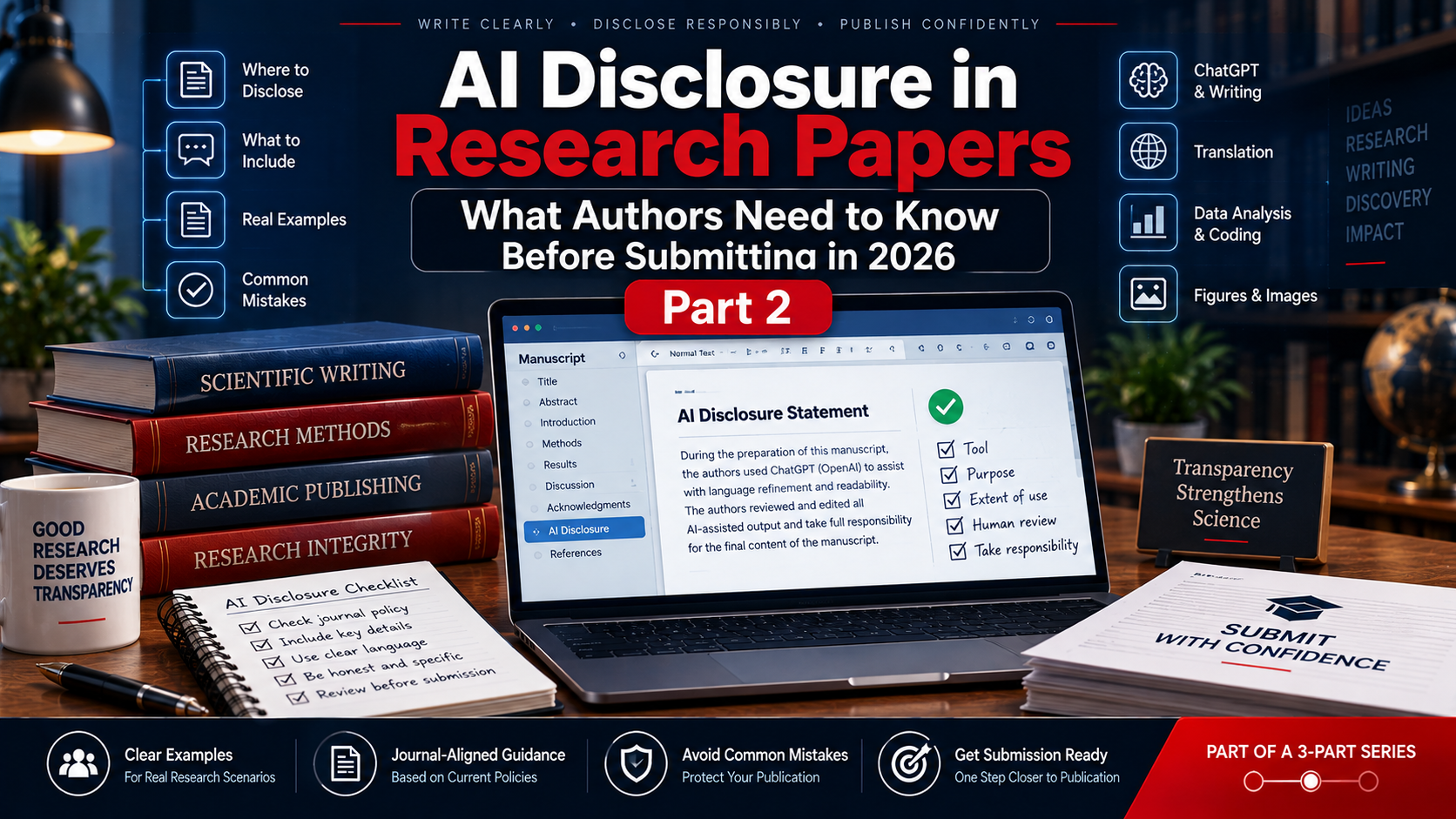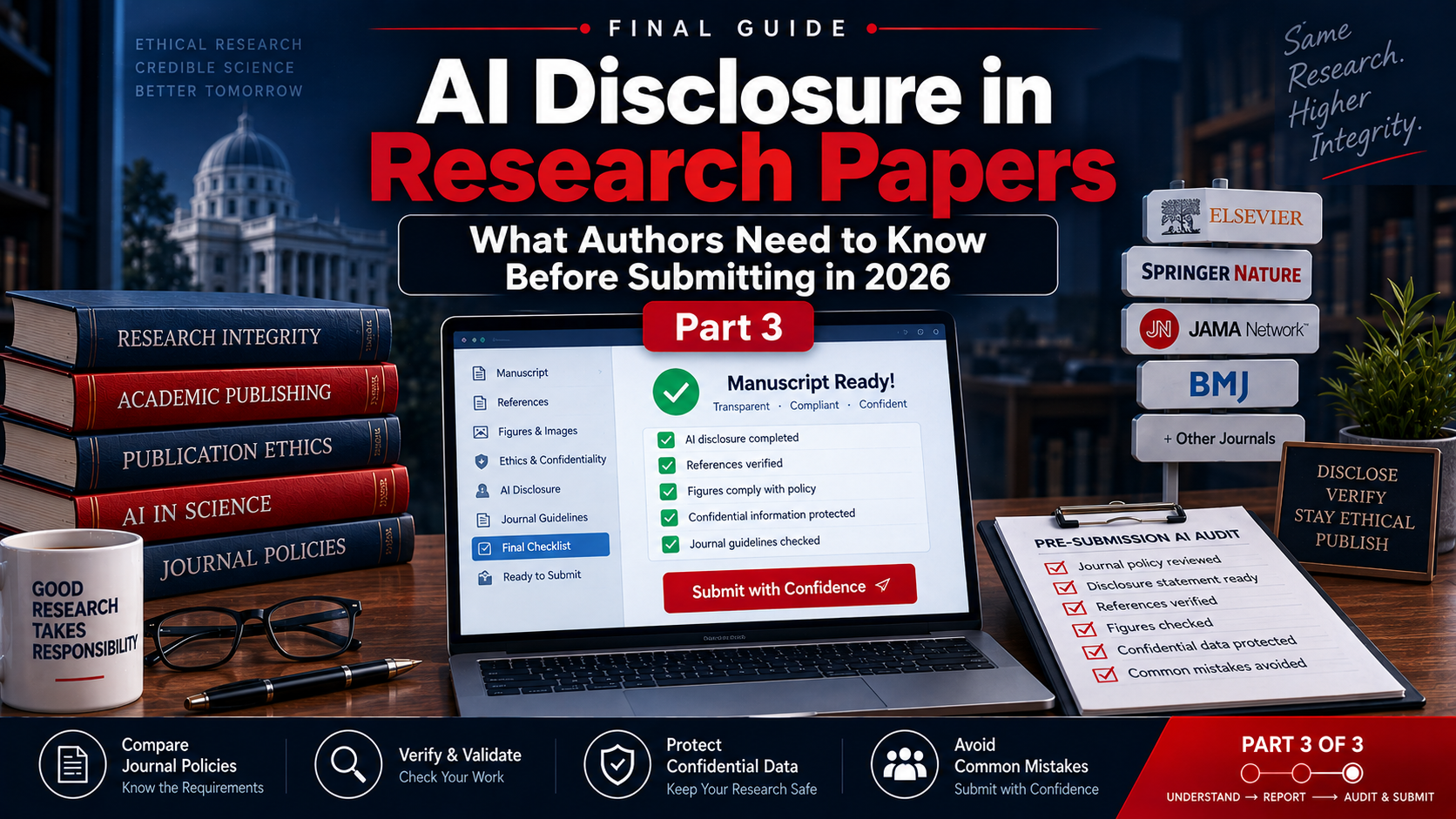
AI Disclosure in Research Papers: What Authors Need to Know Before Submitting in 2026 (Part 3)
If you haven't read Part 1 yet, start here:
AI Disclosure in Research Papers: What Authors Need to Know Before Submitting in 2026 — Part 1
Part 1 explained what AI disclosure means, when disclosure may be necessary, why journal policies matter, and how to decide whether your own AI use needs to be disclosed.
Then, in Part 2, we moved from theory to practice:
AI Disclosure in Research Papers: What Authors Need to Know Before Submitting in 2026 — Part 2
We looked at where to place an AI disclosure statement, what information it should contain, and how disclosure can differ depending on whether AI was used for writing, editing, translation, literature searching, coding, analysis, or figures.
Now comes the final and most important question:
You have disclosed your AI use. Are you actually ready to submit?
The answer depends on more than simply adding one paragraph to your manuscript.
Before you click Submit, you need to make sure your disclosure matches what you actually did, your manuscript follows the target journal's policy, your references and scientific claims have been verified, and confidential research information has not been improperly exposed to an AI system.
This final part is your pre-submission AI audit.
What Part 3 Covers
In this final part, we'll cover:
- What to check after writing your AI disclosure statement
- How to compare your disclosure against the journal's policy
- What editors may ask about your AI use
- Why keeping an AI-use record is valuable
- How to handle AI-generated references
- What to do about AI-assisted figures and images
- Why confidential manuscripts should never be casually uploaded to AI tools
- What happens if you forgot to disclose AI use
- Common AI disclosure mistakes
- A final AI pre-submission checklist
- Ready-to-adapt disclosure templates
- The most important principle to remember before submission
1. Your AI Disclosure Is Not the Final Step
One of the biggest mistakes researchers make is treating AI disclosure as a box they simply need to tick.
For example:
"I used ChatGPT, so I added an AI statement. Done."
Not necessarily.
A disclosure statement tells the editor what you did.
It does not automatically prove that:
- the information is accurate
- references are genuine
- scientific claims are correct
- the manuscript follows journal policy
- AI-generated content was properly reviewed
- confidential information was protected
- figures comply with the journal's requirements
- the authors remain responsible for the final manuscript
Current publisher guidance consistently places responsibility on the human authors.
For example, Elsevier states that authors remain responsible for the accuracy, completeness and integrity of their work, while JAMA requires authors to review AI-generated content and take responsibility for it. BMJ likewise emphasizes transparent declaration and human accountability.
The practical lesson is simple:
Disclosure explains AI involvement. Human review establishes responsibility.
2. Read the Target Journal's AI Policy One More Time
Even if you already checked the journal's policy before writing your manuscript, check it again immediately before submission.
Why?
Because AI policies are evolving rapidly.
A policy that applied when you started writing may not be identical to the policy that applies when you submit.
More importantly, different publishers can require different disclosure locations and levels of detail.
For example:
- Elsevier currently asks authors to include a separate AI declaration for generative AI used in manuscript preparation.
- JAMA requires disclosure of AI-assisted content creation, revision and formatting in the Acknowledgment section, while AI used as part of formal research methods belongs in the Methods section.
- BMJ asks authors to acknowledge AI use in the contributor section and to provide a fuller description in Methods when AI was used during research.
- Nature Portfolio guidance emphasizes transparency, human accountability and appropriate disclosure depending on how AI was used.
Therefore, do not assume:
"I used the format from another journal, so it must be acceptable here."
It may not be.
Your final policy check should answer:
- Does this journal permit the AI use I performed?
- Does it require disclosure?
- Where should the disclosure appear?
- What information must be included?
- Does research-related AI use need to be described in Methods?
- Are AI-generated figures allowed?
- Are there restrictions on AI-generated text?
- Are AI-generated references permitted or discouraged?
- Are there confidentiality restrictions?
- Does the journal require additional information during submission?
3. Your Disclosure Should Match Your Actual AI Use
Your statement should never describe AI use more narrowly than what actually happened.
Suppose you write:
"ChatGPT was used for language editing."
But you actually used it to:
- restructure sections
- generate paragraphs
- suggest interpretations
- summarize papers
- generate references
- rewrite your Discussion
That statement may not accurately represent your use.
A better approach is to describe the actual role of the tool.
For example:
"During manuscript preparation, the authors used ChatGPT to assist with language refinement and organization of selected sections. All AI-assisted output was reviewed and edited by the authors, who take full responsibility for the final manuscript."
The goal is not to make your AI use sound smaller.
The goal is to make the statement accurate.
4. Think in Terms of Four Questions
A useful final audit is to ask four questions for every AI tool you used:
1. What tool did I use?
Example:
- ChatGPT
- Claude
- Gemini
- Microsoft Copilot
- another generative AI system
2. Why did I use it?
Example:
- language refinement
- translation
- literature organization
- brainstorming
- coding assistance
- data analysis
- figure preparation
3. What exactly did it do?
This is the part researchers often leave too vague.
"AI was used" is not particularly informative.
Compare:
"AI was used during manuscript preparation."
with:
"ChatGPT was used to improve the readability and organization of selected paragraphs in the Introduction and Discussion."
The second statement tells the reader substantially more.
4. What did I do afterward?
Your disclosure should make human oversight clear.
For example:
"The authors reviewed and edited the AI-assisted output and take full responsibility for the final content."
This four-question framework is useful because it prevents vague disclosures.
5. Keep an AI-Use Record
You do not necessarily need to submit your entire AI conversation history with every manuscript.
But maintaining an internal record can be extremely useful.
Create a simple table while working:
| Date | Tool | Purpose | Manuscript Section | Human Review |
|---|---|---|---|---|
| 05 Aug 2026 | ChatGPT | Language refinement | Introduction | Yes |
| 07 Aug 2026 | ChatGPT | Outline suggestions | Discussion | Yes |
| 09 Aug 2026 | Gemini | Literature organization | Background | Yes |
| 11 Aug 2026 | AI coding assistant | Code assistance | Methods | Yes |
| 12 Aug 2026 | AI image tool | Figure draft | Figure 2 | Yes |
You can also record:
- model/version where relevant
- important prompts
- major outputs
- changes made afterward
- whether references were independently verified
- whether sensitive information was involved
This becomes particularly valuable if an editor later asks:
"How was AI used in preparing this manuscript?"
Instead of trying to reconstruct your workflow from memory, you have a record.
Elsevier specifically recommends documenting AI use, including the tool and model, how it was used, prompts or outputs where appropriate, and evidence of human review. :contentReference[oaicite:0]{index=0}
6. Do Not Treat AI-Generated References as Automatically Reliable
This deserves special attention.
AI systems can produce references that look completely legitimate.
A citation may contain:
- a realistic author list
- a plausible article title
- a journal name
- a convincing DOI
- a realistic publication year
And still be wrong.
References can be:
- completely fabricated
- incorrectly attributed
- linked to the wrong paper
- given the wrong DOI
- missing authors
- incorrectly dated
- misrepresented by the AI system
This is why you should independently verify every reference suggested by AI.
A practical verification process
For every AI-suggested citation:
Step 1: Search the title.
Step 2: Confirm that the paper actually exists.
Step 3: Confirm the authors.
Step 4: Confirm the journal.
Step 5: Confirm publication details.
Step 6: Verify the DOI or other persistent identifier.
Step 7: Open the original paper.
Step 8: Confirm that the paper actually supports the claim you are making.
Do not stop at:
"The reference exists."
The more important question is:
"Does the original source actually support my statement?"
JAMA advises against using AI tools to generate or format references because of potential accuracy and integrity problems. Elsevier similarly warns that AI-generated citations can be incorrect, hallucinated or fabricated and requires authors to verify sources. :contentReference[oaicite:1]{index=1}
7. AI-Assisted Literature Searching Still Requires Human Verification
AI can be useful for discovering:
- keywords
- alternative terminology
- related concepts
- research themes
- potential papers
- possible research gaps
But discovery is not the same as verification.
For example, an AI system may tell you:
"Several studies have demonstrated that compound X significantly improves outcome Y."
That statement should trigger a verification step.
Find the original studies.
Read them.
Determine:
- what was actually studied
- what population was involved
- what methodology was used
- what the results showed
- whether the conclusion was statistically supported
- whether the study was in vitro, animal or human
- whether the claim is being generalized beyond the evidence
AI can help you find the literature.
It should not become a substitute for reading the literature.
8. Be Especially Careful With AI-Assisted Data Analysis
AI-assisted coding and analysis can be useful, but the consequences of an error can be much larger than a grammatical mistake.
Suppose you ask an AI tool to:
- write statistical code
- clean a dataset
- select a statistical test
- interpret a p-value
- generate a regression model
- explain an unexpected result
You still need to independently verify the work.
Check:
- dataset handling
- variable definitions
- missing-value treatment
- statistical assumptions
- model selection
- code execution
- output
- interpretation
- reproducibility
If AI was part of the actual research methodology, do not hide that behind a generic manuscript-preparation statement.
Research-related AI use generally belongs in the methodological description, with enough information for readers to understand its role.
Elsevier explicitly distinguishes AI used in manuscript preparation from AI used in research methods and says research-process use should be described in the Methods section. JAMA similarly asks authors to report AI used as part of scientific research with appropriate methodological detail and relevant reporting guidance. :contentReference[oaicite:2]{index=2}
9. AI-Generated Figures Need Their Own Check
Images are one of the areas where journal policies can become particularly strict.
There is an important distinction between:
A. An explanatory illustration
For example:
- a conceptual workflow
- a graphical explanation
- a schematic
- an educational illustration
and
B. A representation of primary research data
For example:
- microscopy
- western blot
- histology
- patient images
- experimental results
You should never use generative AI to fabricate or alter primary research data.
That is not simply an "AI disclosure" issue.
It is a research integrity issue.
Elsevier explicitly prohibits using AI to create or alter images representing primary observed or experimental data that were not directly obtained in the research. :contentReference[oaicite:3]{index=3}
Some publishers may also have additional restrictions on AI-generated artwork or illustrations.
Therefore:
Never assume that disclosure automatically makes an AI-generated figure acceptable.
Check the target journal's image policy separately.
10. Do Not Upload Confidential Manuscripts Carelessly
This is one of the most important practical issues.
Imagine that you have received reviewer comments or are preparing a manuscript containing:
- unpublished experimental results
- patient information
- proprietary data
- confidential datasets
- unpublished figures
- intellectual property
- material belonging to collaborators
You copy everything into a public AI chatbot and ask:
"Rewrite this manuscript."
You have now created a confidentiality and data-governance question.
The fact that the AI tool is popular does not automatically mean it is appropriate for confidential research material.
Publisher policies increasingly emphasize confidentiality, privacy and intellectual-property protection.
Elsevier, for example, warns that confidential unpublished manuscripts should not be uploaded into external AI systems in ways that could compromise confidentiality or intellectual property. :contentReference[oaicite:4]{index=4}
Before uploading research material, consider:
- What information am I sharing?
- Is it confidential?
- Does it contain personal data?
- Do I have permission to upload it?
- What does the AI service's data policy say?
- Is the institutional version different from the public version?
- Does my university or organization have its own AI policy?
When in doubt:
Do not upload confidential research content simply because the AI tool makes the task easier.
11. What If You Forgot to Disclose AI Use?
This situation is more common than many researchers realize.
Perhaps you:
- used AI months ago
- forgot about it
- assumed editing did not count
- copied AI-assisted text into your manuscript
- discovered the journal's disclosure requirement only after submission
What should you do?
Before submission
This is the easiest situation to correct.
Review your workflow.
Determine exactly what AI did.
Check the journal policy.
Add an appropriate disclosure if required.
After submission
Do not automatically assume that the only option is to remain silent.
If the AI use is material and should have been disclosed, contact the journal or editorial office and ask how they want you to proceed.
After publication
The situation can become more complicated.
Policies differ, but failure to disclose can lead to editorial action.
JAMA's current guidance states that incomplete disclosure or failure to disclose AI use can result in rejection or postpublication corrective action. :contentReference[oaicite:5]{index=5}
The important principle is:
Correct an omission rather than allowing an inaccurate record to remain unaddressed.
12. What If an Editor Asks for More Information?
Do not panic.
An editor asking about AI use does not automatically mean that your manuscript has been rejected.
They may simply want clarification.
For example:
"Please provide additional information regarding your use of ChatGPT during manuscript preparation."
A useful response should be factual and specific.
You can explain:
- which tool was used
- why it was used
- which sections were affected
- whether it generated or edited content
- how the authors reviewed the output
- whether references were independently verified
- whether confidential information was entered
- how the final version was prepared
Avoid defensive statements such as:
"The AI did not really write anything."
If the tool did contribute to the manuscript, explain what it actually did.
Transparency is more useful than minimizing the role of the technology.
13. Common AI Disclosure Mistakes Before Submission
Let's turn everything into a quick list.
Mistake 1: Writing "AI was used"
Too vague.
Say what tool was used and for what purpose.
Mistake 2: Copying another journal's disclosure statement
A statement acceptable for one publisher may not satisfy another.
Always check the target journal.
Mistake 3: Saying "AI was only used for editing" when it did much more
Your statement should reflect your actual workflow.
Mistake 4: Forgetting research-related AI use
AI used for statistical analysis, coding, prediction, image analysis or other research methodology may require methodological reporting rather than merely a manuscript-preparation acknowledgment.
Mistake 5: Assuming disclosure makes everything permissible
It doesn't.
A prohibited use does not become acceptable simply because you disclose it.
Mistake 6: Trusting AI-generated references
Verify every reference against the original source.
Mistake 7: Uploading confidential research material
Check privacy, confidentiality and institutional requirements before sharing research content with external AI tools.
Mistake 8: Forgetting AI-generated figures
Check the journal's figure and image policy separately.
Mistake 9: Treating AI as an author
Current publisher guidance does not treat AI systems as authors.
Human authors retain responsibility for the work. :contentReference[oaicite:6]{index=6}
Mistake 10: Not keeping a record
If you cannot remember which AI tool you used or what it did, reconstructing an accurate disclosure later becomes unnecessarily difficult.
14. A Practical AI Pre-Submission Audit
Before clicking Submit, run this audit.
AI Use
- Did I use any generative AI?
- Which tools did I use?
- What did I use each tool for?
- Did AI affect the manuscript text?
- Did AI affect figures?
- Did AI assist with coding or analysis?
- Did AI assist with literature searching?
- Did AI help generate references?
Journal Policy
- Did I read the target journal's current AI policy?
- Does the journal permit my specific use?
- Where does the journal require disclosure?
- Does it require a specific format?
- Does AI used in research need to be described in Methods?
- Are AI-generated images allowed?
Verification
- Did I verify every AI-generated factual claim?
- Did I verify every AI-suggested reference?
- Did I check every DOI?
- Did I read the original sources?
- Did I verify statistical interpretations?
- Did I review all AI-assisted code?
Confidentiality
- Did I upload unpublished research to an AI system?
- Did I include personal or patient information?
- Did I upload confidential reviewer comments?
- Did I upload copyrighted material I do not have permission to share?
- Did I follow institutional data-protection requirements?
Disclosure
- Is my disclosure accurate?
- Does it identify the relevant tool?
- Does it explain the purpose?
- Does it describe the extent of use where required?
- Does it confirm human review and responsibility?
- Is it located in the section required by the journal?
If you can confidently answer these questions, your AI disclosure is much more likely to be aligned with your actual workflow and the journal's expectations.
15. Ready-to-Adapt AI Disclosure Templates
These examples are starting points—not universal statements.
Always adapt them to your actual use and the target journal's requirements.
Example 1: Language Refinement
During the preparation of this manuscript, the authors used [AI TOOL] to assist with language refinement and readability. The authors reviewed and edited all AI-assisted output and take full responsibility for the final content of the manuscript.
Example 2: Translation
During preparation of this manuscript, [AI TOOL] was used to assist with translation from [LANGUAGE] to English. The translated content was subsequently reviewed and edited by the authors, who take full responsibility for the accuracy and integrity of the final manuscript.
Example 3: Literature Organization
[AI TOOL] was used to assist with organizing and categorizing literature identified during the preparation of this manuscript. All suggested sources were independently verified by the authors against the original publications.
Example 4: Coding Assistance
During the research process, [AI TOOL] was used to assist with the development and refinement of [TYPE OF CODE/ANALYSIS]. All code and resulting analyses were reviewed and validated by the authors. The authors take responsibility for the accuracy and reproducibility of the reported analysis.
For research-related AI use, this type of information may belong in the Methods section depending on the journal.
Example 5: Combined Use
During the preparation of this manuscript, the authors used [AI TOOL] to assist with language refinement, organization of selected sections, and development of an initial outline. All AI-assisted output was critically reviewed, verified, and edited by the authors. The authors take full responsibility for the accuracy, integrity, and final content of the manuscript.
16. Do Not Copy These Templates Blindly
A disclosure statement is not a legal disclaimer that you can paste into every manuscript.
The correct wording depends on:
- the tool
- the version
- the purpose
- the extent of use
- the research field
- the journal
- the publisher
- whether AI was involved in the research itself
- whether AI-generated material appears in the manuscript
For example, Elsevier provides a specific declaration format for AI used in manuscript preparation, while JAMA asks for more detailed information such as the tool, version, manufacturer, dates of use and description of the affected content. BMJ asks authors to describe what AI technology was used, why it was used and how it was used. :contentReference[oaicite:7]{index=7}
So the best template is not necessarily the longest one.
It is the one that is:
Accurate + Specific + Journal-Compliant + Honest
17. The Most Important Distinction: Assistance vs Accountability
AI can assist with:
- wording
- organization
- translation
- brainstorming
- literature discovery
- coding
- analysis
- visualization
- other research tasks
But AI cannot take responsibility for your paper.
That responsibility remains with the human authors.
This distinction is central to current scholarly publishing guidance.
AI may contribute to a workflow.
It does not replace:
- scientific judgment
- critical interpretation
- source verification
- methodological responsibility
- ethical decision-making
- authorship accountability
Nature's current guidance similarly emphasizes that human accountability remains non-transferable and that AI should support—not replace—scholarly judgment. :contentReference[oaicite:8]{index=8}
18. The Three-Part AI Disclosure Framework
Let's bring the entire series together.
Part 1 — Understand
What is AI disclosure?
You learned:
- why disclosure exists
- when AI use may need disclosure
- why journal policies differ
- how to identify potentially disclosable AI use
Part 2 — Report
How do I disclose AI use?
You learned:
- where disclosure may belong
- what information to include
- how to describe different AI-assisted tasks
- how to write practical disclosure statements
Part 3 — Audit
Am I actually ready to submit?
You learned:
- how to check your disclosure
- how to verify AI-assisted content
- how to handle references
- how to document AI use
- how to protect confidential information
- how to handle AI-assisted figures and analysis
- what to do if you forgot to disclose AI use
- how to perform a final pre-submission audit
That gives you a complete workflow:
Understand → Report → Audit → Submit
19. The 60-Second Rule Before You Submit
Just before you click Submit, ask yourself:
"If the editor asked me exactly how I used AI in this manuscript, could I explain it honestly and specifically?"
If the answer is yes, you are probably in a much better position.
If the answer is no, stop.
Review your workflow.
Check the journal policy.
Verify your AI-assisted material.
Update your disclosure.
Then submit.
Final Takeaways
AI disclosure should not be viewed as something researchers do because they are "in trouble" for using AI.
It is part of transparent scholarly communication.
The strongest approach is straightforward:
- Know the journal's policy.
- Track how you use AI.
- Disclose relevant use accurately.
- Verify everything AI contributes.
- Never fabricate data, references or results.
- Protect confidential and personal information.
- Check figure and image requirements separately.
- Keep humans responsible for scientific judgment and the final manuscript.
The goal is not to hide AI use.
The goal is to use AI responsibly enough that you can explain exactly what it did—and stand behind everything that remains in your paper.
🚀 FREE RESEARCHER RESOURCE
🚀 FREE RESEARCHER RESOURCE
AI in Research: The Complete Ethical Researcher's Guide (2026 Edition)
Master ethical AI use, disclosure requirements, literature reviews, prompt engineering, citation verification, and responsible AI workflows.
👉 Download the FREE Guide
Final Thoughts
The question researchers should no longer ask is:
"Can I use AI in research?"
The better question is:
"Can I use AI in a way that is transparent, verifiable, ethical and consistent with the journal's requirements?"
That is the standard that matters.
AI is becoming part of academic research workflows.
But responsible research still depends on the same fundamentals:
Evidence.
Verification.
Transparency.
Human judgment.
Accountability.
Use AI where it genuinely helps.
Disclose it when required.
Verify what it produces.
And remember:
The tool can assist your research. You are still responsible for the science.
Frequently Asked Questions
Do I need to disclose every use of AI?
Not necessarily.
Policies distinguish between different types of AI use. Basic spelling, grammar and punctuation assistance may be excluded from disclosure requirements in some publisher policies, while substantive AI-assisted writing, research methods, coding, analysis or other uses may require disclosure.
Always check the target journal's current policy.
Can I use ChatGPT to improve my research paper?
Potentially, yes, depending on the journal and the way you use it.
The important issues are the nature of the assistance, disclosure requirements, verification, confidentiality and human responsibility.
Can AI be listed as an author?
No. Major publisher guidance does not treat AI tools as authors because authorship requires human accountability and responsibility.
Can I use AI to find research papers?
AI can assist with literature discovery and organization, but you should independently verify every source and read the original publication before relying on it.
Can I use AI to generate references?
You should not rely on AI-generated references without independent verification. AI systems can produce inaccurate or fabricated citations.
Do I need to disclose basic grammar correction?
Not necessarily. Several current publisher policies distinguish basic grammar, spelling and punctuation checks from substantive generative AI assistance.
However, the target journal's policy should always take priority.
What if AI helped me write code for my research?
If AI assistance affected the research methodology or analysis, it may need to be described in the Methods section. You should also validate the code and ensure that the analysis is reproducible.
Can I upload my unpublished manuscript to ChatGPT?
Do not assume that it is safe simply because you are using a popular AI tool.
Consider confidentiality, privacy, intellectual property, institutional rules and the specific AI service's data practices before uploading unpublished research.
What should I do if I forgot to disclose AI use?
If you have not submitted yet, review your AI use and update the manuscript according to the journal's requirements.
If you have already submitted, consider contacting the journal if the omitted AI use is material and should have been disclosed.
Is AI disclosure the same as asking permission?
No.
Disclosure means transparently reporting relevant AI use.
Whether a particular use is permitted is a separate question determined by the journal's policy.
Conclusion
AI disclosure is becoming a normal part of responsible research publishing.
But disclosure alone is not enough.
Researchers must also verify AI-assisted content, protect confidential information, check references, follow journal-specific rules and remain accountable for every scientific claim in the manuscript.
The safest workflow is:
Understand the policy → Track your AI use → Disclose accurately → Verify independently → Audit before submission.
If you follow that workflow, AI becomes a tool you can explain and defend—not a hidden risk in your manuscript.
This concludes the 3-part series on AI disclosure in research papers.
Source Verification
This article is based on information obtained from:
• Original research publication and scholarly publishing guidance (where available)
• Official journal and publisher policies, including JAMA Network, Elsevier, BMJ and Nature Portfolio
• Peer-reviewed scientific literature and publication-ethics guidance
Verification Status
All factual claims, publisher-policy statements, disclosure requirements and research-integrity guidance were verified against the best available official sources at the time of publication.
Last Verified
10 September 2026