AI Disclosure in Research Papers: What Authors Need to Know Before Submitting in 2026 (Part 2)
If you haven't read Part 1 yet, start here before moving to Part 2:
AI Disclosure in Research Papers: What Authors Need to Know Before Submitting in 2026 — Part 1
The goal is not simply to tell you that AI disclosure exists.
The goal is to help you understand exactly what to do before you click "Submit."
In Part 1, we established the fundamentals of AI disclosure in academic publishing: why journals care about transparency, why AI use during research is different from AI use during manuscript preparation, when basic language assistance may be treated differently from substantive AI-assisted writing, and why authors remain responsible for everything submitted under their names.
Now we move from the question of "Do I need to disclose AI use?" to the question researchers actually face while preparing a manuscript:
"What exactly should I write in my AI disclosure statement?"
There is no single disclosure statement that works for every journal.
Different publishers and journals have different requirements regarding where AI use should be reported and what information authors should provide.
For example, Elsevier currently asks authors who use generative AI during manuscript preparation to include a separate AI declaration near the end of the manuscript, immediately before the references. BMJ asks authors to acknowledge AI use in the contributor section and recommends a fuller description in the Methods section when AI was used during research. Nature Portfolio generally asks authors to document AI use in the Methods section or another suitable location when a Methods section is unavailable.
Therefore, the examples in this article are adaptable examples—not universal publisher templates.
Always compare your final statement with the current instructions of the journal you are submitting to.
Where Should You Put an AI Disclosure Statement?
This is one of the most confusing aspects of AI disclosure.
There is no universally required location.
Depending on the publisher, journal, article type, and nature of AI use, disclosure may appear in:
- A dedicated AI declaration
- Acknowledgments
- Contributor information
- Methods
- Figure legends or captions
- Supplementary information
- Another location specified by the journal
The correct location depends on what the AI actually did.
A useful distinction is:
AI used to prepare the manuscript
This may be reported through an AI declaration, acknowledgment, contributor statement, or another location specified by the journal.
AI used as part of the research
This generally requires more methodological detail because the AI is part of the scientific process.
For example, if an AI model was used to classify images, process data, generate predictions, or assist with an analytical workflow, readers may need to understand how it was used in order to evaluate the study.
BMJ explicitly distinguishes AI used during research from general content preparation and recommends fuller description in the Methods section when AI was used in the research. :contentReference[oaicite:1]{index=1}
Nature Portfolio likewise states that AI use should be documented in the Methods section, or in a suitable alternative where no Methods section exists. :contentReference[oaicite:2]{index=2}
Why the Location of Disclosure Matters
Imagine a reader discovers that an AI model was used to analyze experimental data.
That information is not merely an editorial footnote.
It may be part of the methodology.
The reader may reasonably want to know:
- Which system was used?
- What version was used?
- What task did it perform?
- What inputs were provided?
- What outputs did it produce?
- How were the outputs evaluated?
- What human oversight was applied?
That information belongs much closer to the scientific description of the research.
Now consider a different scenario.
You wrote the manuscript yourself and used an AI tool to improve sentence structure.
The AI did not participate in the experiment.
In that situation, a journal may ask for a manuscript-preparation disclosure rather than a methodological description.
This is why simply copying an AI disclosure statement from another paper can be a mistake.
What Information Should an AI Disclosure Statement Include?
Although requirements differ, a useful disclosure generally answers three questions:
1. What AI tool did you use?
Name the system or service.
For example:
- ChatGPT
- Microsoft Copilot
- Gemini
- Claude
- Another generative AI system
Avoid vague statements such as:
"AI was used during preparation."
That does not tell the reader enough.
2. Why did you use it?
Explain the purpose.
For example:
- Language editing
- Improving readability
- Translation
- Manuscript organization
- Literature searching
- Coding assistance
- Data analysis
- Figure preparation
3. What did you do with the output?
This is often the most important part.
Explain that the authors reviewed the output and retained responsibility for the final manuscript where applicable.
Elsevier's current policy specifically asks authors to document the AI tool, its purpose, and the extent of human oversight. Its suggested declaration also confirms that authors reviewed and edited the output and remain responsible for the publication. :contentReference[oaicite:3]{index=3}
A Simple Formula for Writing an AI Disclosure
For manuscript-preparation use, you can think about the statement as:
Tool + Purpose + Human Review + Responsibility
For example:
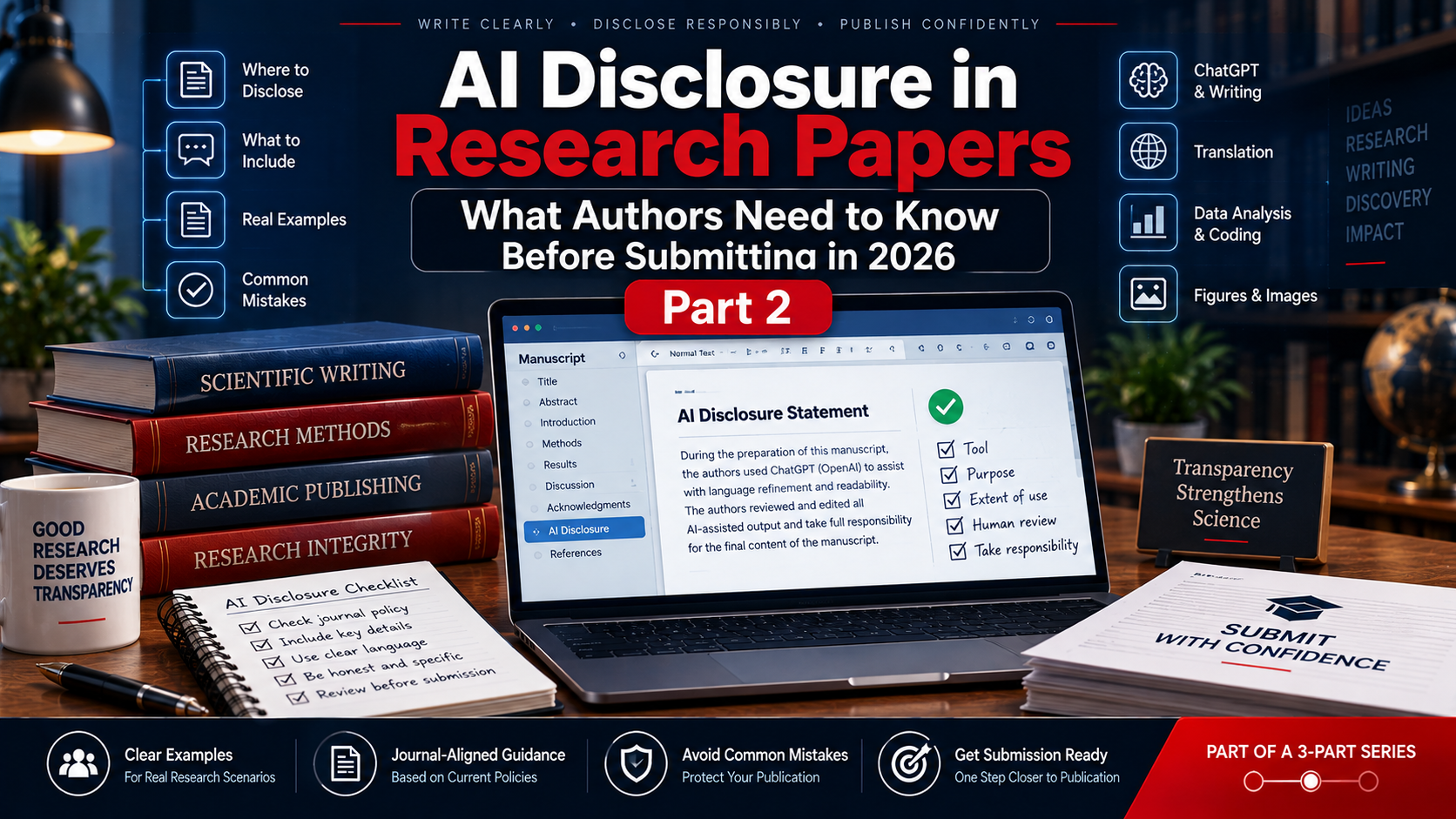
During the preparation of this manuscript, the authors used [AI TOOL] to assist with [PURPOSE]. The authors reviewed and edited the generated content and take full responsibility for the final version of the manuscript.
This is a useful starting structure.
However, do not assume that this exact wording satisfies every journal.
The target journal may require additional information or a specific disclosure location.
AI Disclosure Example 1: ChatGPT Used for Language Improvement
Suppose you wrote your manuscript yourself and used ChatGPT to improve sentence clarity and readability.
An adaptable disclosure could be:
During the preparation of this manuscript, the authors used ChatGPT to assist with language refinement and readability. The authors reviewed and edited all AI-assisted output and take full responsibility for the final content of the manuscript.
This communicates:
- The tool used
- The purpose
- Human review
- Author responsibility
If the journal has its own required format, use that format instead.
AI Disclosure Example 2: AI Used for Extensive Copy Editing
Suppose you wrote the manuscript but used an AI system to substantially improve sentence structure throughout several sections.
A more specific statement could be:
During manuscript preparation, the authors used [AI TOOL] to improve sentence structure, clarity, and organization of selected sections. All AI-assisted changes were reviewed and edited by the authors, who remain fully responsible for the accuracy and integrity of the final manuscript.
This is more transparent than simply saying:
"AI was used for editing."
The reader gets a clearer understanding of the extent and purpose of the assistance.
AI Disclosure Example 3: AI Used for Translation
Suppose the original manuscript was prepared in another language and AI was used to produce an English translation.
An adaptable example is:
During preparation of the manuscript, the authors used [AI TOOL] to assist with translation from [LANGUAGE] into English. The translated text was subsequently reviewed and edited by the authors for scientific accuracy, terminology, and fidelity to the original manuscript. The authors take full responsibility for the final content.
Translation deserves particular attention because fluent language does not necessarily guarantee scientific accuracy.
A translation system can alter:
- Technical terminology
- Units
- Statistical descriptions
- Drug names
- Biological terminology
- Negations
- Numerical information
Therefore, the human review statement should reflect what actually happened.
AI Disclosure Example 4: AI Used to Generate an Outline
Suppose you asked an AI system to suggest an initial structure for your manuscript.
For example:
"Suggest a logical structure for a research paper on..."
You then developed the actual manuscript yourself.
Depending on the target journal's policy and the extent of the AI contribution, an adaptable statement could be:
During the preparation of this manuscript, the authors used [AI TOOL] to assist in developing an initial organizational outline. The final structure and content were developed and reviewed by the authors, who remain responsible for the manuscript.
Whether this use requires formal disclosure should still be checked against the target journal's current policy.
AI Disclosure Example 5: AI Used for Literature Searching
This situation requires additional care.
Suppose you used an AI-powered research tool to identify potentially relevant papers.
The AI helped you discover literature, but you independently accessed and verified the original papers.
A possible disclosure could be:
The authors used [AI TOOL] to assist in identifying potentially relevant literature during the literature-search process. All sources considered for inclusion were independently reviewed and verified by the authors using the original publications.
The important part is the second sentence.
AI should not become the final authority for what a research paper says.
Always verify important claims against the original source.
AI Disclosure Example 6: AI Used for Research Analysis
This is fundamentally different from using AI for grammar correction.
Imagine an AI model was used to assist with data classification.
Your disclosure needs to be substantially more informative.
For example:
An AI-assisted classification model ([TOOL/MODEL NAME, VERSION IF APPLICABLE]) was used to classify [TYPE OF DATA] according to [TASK]. The model outputs were reviewed using [VALIDATION/REVIEW PROCESS], and final classifications were verified by the research team.
The exact information required will depend on the study and journal.
For research-related AI use, readers may need sufficient information to understand how the AI contributed to the methodology.
Do not hide a substantive methodological role inside a generic "AI-assisted writing" statement.
AI Disclosure Example 7: AI Used for Coding Assistance
Researchers increasingly use generative AI to help write or debug code.
For example, you might ask an AI system to:
- Suggest Python code
- Explain an error
- Convert code between languages
- Generate a data-processing function
- Help structure a script
If AI-assisted coding contributed to your research methodology, consider whether the use should be described in the Methods or another methodological section according to your journal's requirements.
An adaptable example might be:
[AI TOOL] was used to assist with the development and debugging of code used for [TASK]. All generated code was reviewed, tested, and modified by the authors before use in the analysis.
The important principle is:
Do not describe AI-assisted code as though it was independently validated simply because it executed successfully.
Code can run without being scientifically correct.
AI Disclosure Example 8: AI Used to Interpret Statistical Output
This is another area where researchers should be cautious.
Suppose you performed statistical analysis using established software and then asked an AI tool to explain the statistical output in simpler language.
The AI was not necessarily performing the analysis itself.
It was helping you understand or communicate the results.
An adaptable disclosure might be:
The authors used [AI TOOL] to assist in interpreting and explaining selected statistical outputs in plain language during manuscript preparation. The statistical analyses and final interpretation were independently reviewed by the authors.
Again, the precise disclosure requirement depends on the journal.
More importantly, researchers should not allow an AI system to make unsupported claims about statistical significance, causality, effect sizes, or clinical relevance.
AI Disclosure Example 9: AI Used for Figure Preparation
AI-assisted figures require particularly careful consideration.
There are several very different scenarios.
Scenario A: AI helped organize an existing figure
For example, AI assisted with layout or presentation.
Scenario B: AI generated a visual element
The system created an image or illustration.
Scenario C: AI modified experimental imagery
The system altered or reconstructed an image associated with the research.
These are not equivalent.
Some publishers place specific restrictions on generative AI images.
For example, Nature Portfolio currently states that generative AI images are not permitted in its publications except in limited circumstances where AI itself is the subject of the research and the use is assessed appropriately. :contentReference[oaicite:4]{index=4}
Therefore, never assume that "I disclosed it" automatically means an AI-generated figure is acceptable.
Disclosure does not make a prohibited use permissible.
Always check the journal's image and AI policies separately.
AI Disclosure Example 10: AI Used for Both Writing and Research
Some projects involve AI at multiple stages.
For example:
- AI-assisted literature discovery
- AI-assisted coding
- AI-assisted analysis
- AI-assisted manuscript editing
In such cases, a single vague sentence may not provide enough information.
Instead, separate the uses clearly.
For example:
During the preparation of this manuscript, the authors used [AI TOOL A] to assist with language refinement and [AI TOOL B] to assist with literature organization. An AI-assisted computational tool ([TOOL/MODEL]) was also used as part of the analysis described in the Methods section. All AI-assisted outputs were reviewed by the authors, who remain responsible for the accuracy, integrity, and final interpretation of the work.
This structure makes the different roles of AI easier to understand.
Should You Mention the AI Tool's Version?
When the journal requires detailed reporting, providing the tool name and relevant version or model information can improve reproducibility.
For example:
ChatGPT using [MODEL/VERSION]
or:
[MODEL NAME], version [VERSION]
However, do not invent version information.
If you did not record the version at the time, check what information is available from the tool or your records.
If the journal does not require a version number, follow its instructions.
The principle is simple:
Report what you actually know. Never fabricate technical details to make a disclosure appear more precise.
Should You Include Your Prompts?
Usually, researchers do not need to place every prompt they have ever used inside the manuscript.
However, some journals or editors may request additional information about the AI interaction, particularly when AI played a substantial role in the research.
BMJ's current guidance, for example, notes that authors may consider providing a summary of inputs, outputs, and how AI-generated output was reviewed as supplementary information or additional information for editorial review. :contentReference[oaicite:5]{index=5}
This is particularly relevant when AI is part of the research methodology.
For routine language assistance, providing hundreds of prompts would rarely be useful.
For reproducible computational research, however, the details of the AI-assisted workflow may be much more important.
Should AI Use Go in the Acknowledgments?
Sometimes—but not always.
Acknowledgments are commonly used to recognize assistance that does not qualify for authorship.
However, an AI disclosure is not necessarily equivalent to acknowledging a human contributor.
Some journals explicitly prescribe a separate AI declaration.
Elsevier, for example, currently asks for a separate declaration section for relevant generative AI use during manuscript preparation. :contentReference[oaicite:6]{index=6}
BMJ has a different structure and asks for an acknowledgment of AI use in the contributor section, with fuller methodological reporting when AI was used in research. :contentReference[oaicite:7]{index=7}
Nature Portfolio generally directs authors toward disclosure in the Methods section or an appropriate alternative.
Therefore:
Do not automatically put every AI disclosure in the Acknowledgments section.
Follow the target journal's instructions.
Should AI Use Be Mentioned in the Methods Section?
If AI was part of the research process, the answer is often yes or something closely related to yes.
Consider this example:
A researcher uses an AI model to analyze microscopy images.
That is part of the research methodology.
A reader may need to know:
- What model was used?
- What images were analyzed?
- What task was performed?
- How was the model applied?
- How were results validated?
That information belongs with the methodological description rather than being buried in a generic acknowledgment.
Nature Portfolio's current policy specifically calls for AI use to be documented in the Methods section, where appropriate. :contentReference[oaicite:8]{index=8}
What About Basic Grammar and Spelling Checks?
This is an important exception.
Some publishers explicitly state that basic grammar, spelling, and punctuation checks do not require a formal AI declaration.
Elsevier's current policy says basic checks of grammar, spelling, and punctuation do not need a declaration. It distinguishes these from situations where an AI tool makes substantive changes to sentence structure or organization. :contentReference[oaicite:9]{index=9}
This distinction matters.
Compare:
Use A:
"Fix the spelling mistakes in this paragraph."
with:
Use B:
"Rewrite this discussion section to make the argument more persuasive and reorganize the logic."
These are not equivalent.
The first is a basic language correction.
The second involves substantive transformation of the manuscript.
When the AI begins changing structure, argumentation, or content, check the journal's disclosure requirements carefully.
What You Should NOT Write in an AI Disclosure
Researchers sometimes make their disclosure so vague that it becomes practically meaningless.
Avoid statements such as:
"AI was used."
Too vague.
Avoid:
"The authors used artificial intelligence responsibly."
This describes an intention, not what actually happened.
Avoid:
"AI tools were used for research purposes."
This does not tell the reader which tool or what task it performed.
Avoid:
"ChatGPT was used to write the manuscript."
This may be technically true but lacks important context.
Did it generate the entire manuscript?
Rewrite selected paragraphs?
Suggest an outline?
Translate text?
Edit grammar?
These are very different levels of involvement.
Do Not Overstate Your Human Review
Be honest about what you actually reviewed.
If an AI tool generated several paragraphs and you lightly edited them, do not claim:
"All AI-generated content was extensively independently verified."
unless that is genuinely what happened.
Likewise, don't claim that AI output was independently validated if no validation occurred.
Transparency only works when the disclosure itself is accurate.
Do Not Use "AI-Assisted" as a Blanket Explanation
The phrase "AI-assisted" can cover almost anything.
That is precisely the problem.
Consider:
"The manuscript was AI-assisted."
What does that mean?
Did AI:
- Correct spelling?
- Translate the manuscript?
- Write the Introduction?
- Analyze the dataset?
- Generate figures?
- Write code?
- Identify references?
The disclosure should provide enough information to distinguish these situations.
The Difference Between Disclosure and Permission
This is perhaps the most important lesson in this entire article.
Disclosure does not automatically make an AI use acceptable.
Imagine a journal prohibits generative AI-generated figures.
You cannot solve the problem simply by writing:
"Figure 2 was generated using AI."
You have disclosed the use.
But if the journal prohibits that use, the figure may still be unacceptable.
Likewise, if a journal requires human authorship of the scientific reasoning, disclosing that AI generated your core conclusions does not make the practice acceptable.
Nature Portfolio's current framework explicitly distinguishes permitted assistive use from prohibited uses that replace scholarly judgment, compromise confidentiality, or generate unverifiable outputs. :contentReference[oaicite:10]{index=10}
Therefore, always ask two separate questions:
1. Do I need to disclose this?
and
2. Is this use permitted by my journal?
They are not the same question.
What About AI-Generated References?
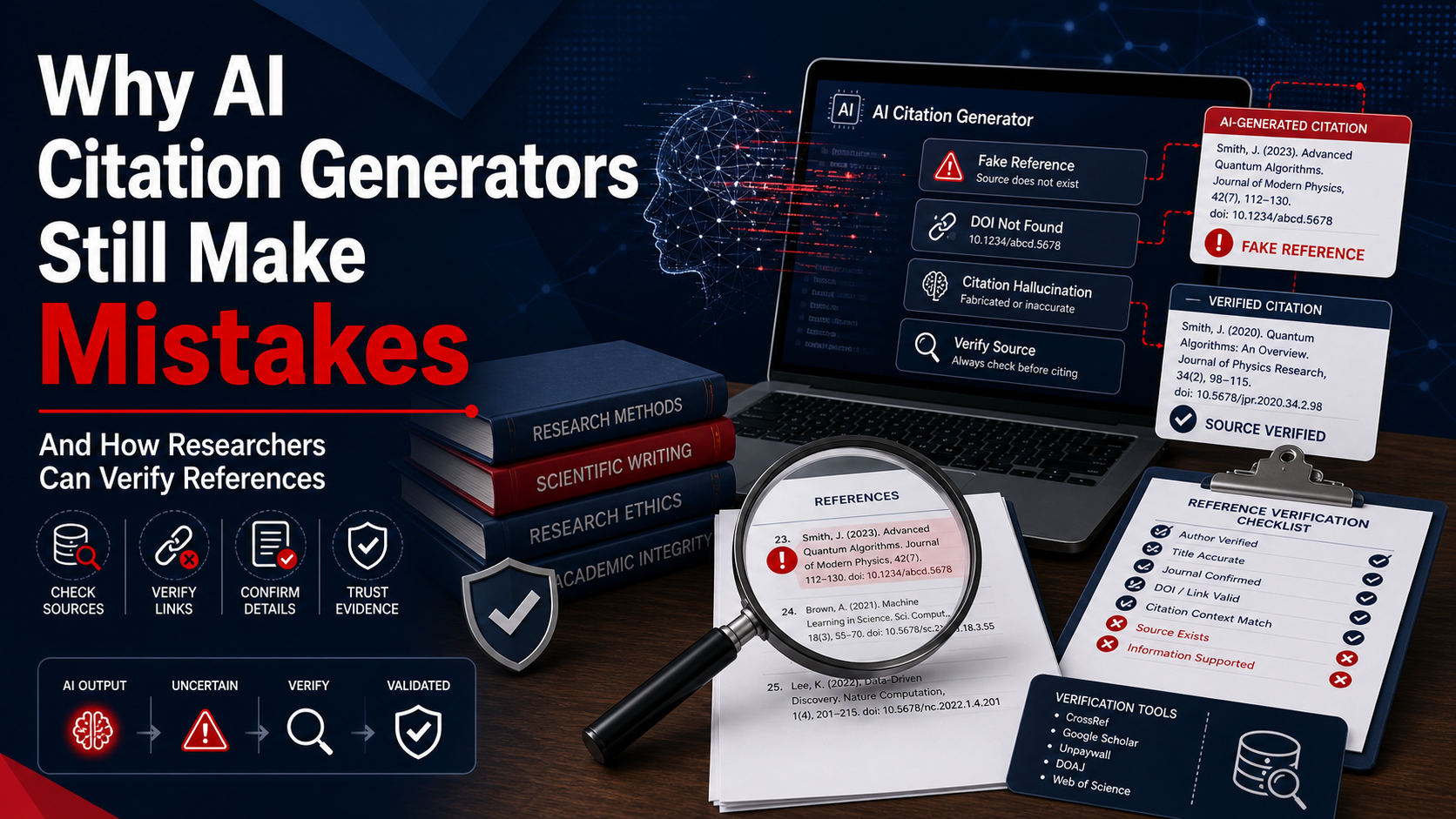
Do not use an AI disclosure statement as an excuse to use unreliable references.
AI systems can produce citations that look authentic but contain errors or may not exist.
Even when a reference exists, the AI may incorrectly describe what the paper reported.
This is why every reference used in a manuscript should be independently verified.
Current Elsevier guidance specifically emphasizes careful verification of AI-generated references, while JAMA's current guidance also warns against AI-generated or AI-formatted bibliographic references in its relevant publication context.
The safest workflow is:
AI suggestion → Locate original paper → Verify metadata → Read relevant section → Cite the original source
Never:
AI suggestion → Copy citation → Submit
What About Confidential Manuscripts?
This is another area researchers frequently overlook.
Suppose you receive reviewer comments on an unpublished manuscript and decide to paste the entire document into a public AI chatbot.
You may be exposing confidential or unpublished research to an external system.
This can create confidentiality, intellectual-property, privacy, or contractual concerns.
Elsevier currently warns that submitting manuscripts or portions of them to AI tools can raise confidentiality and intellectual-property concerns. :contentReference[oaicite:11]{index=11}
Nature Portfolio similarly states that unpublished manuscripts and peer-review material should not be uploaded to unsecured or public AI systems. :contentReference[oaicite:12]{index=12}
The same principle applies to:
- Unpublished datasets
- Patient information
- Personal information
- Proprietary research
- Confidential peer-review comments
- Grant proposals
- Industry research
- Restricted institutional documents
Before uploading anything, understand where the data will go and what your institution, ethics approval, funder, employer, or journal permits.
A Practical AI Disclosure Checklist
Before submitting your manuscript, answer these questions.
Tool
☐ Did I record the name of every AI tool used?
Purpose
☐ Do I know exactly why I used each tool?
Extent
☐ Do I know which parts of the research or manuscript were affected?
Verification
☐ Did I independently verify important AI-generated information?
References
☐ Did I verify every AI-suggested reference against the original source?
Methodology
☐ If AI was part of the research process, did I describe it appropriately in the Methods or equivalent section?
Figures
☐ Did I check whether the journal permits AI-generated or AI-assisted figures?
Confidentiality
☐ Did I avoid uploading confidential or sensitive material to inappropriate AI systems?
Disclosure
☐ Does my journal require an AI declaration?
Location
☐ Am I placing the declaration where the journal specifically asks for it?
Responsibility
☐ Do I remain responsible for the final manuscript?
If you cannot confidently answer these questions, your manuscript may not yet be ready for submission.
The Best Time to Record AI Use Is Before You Need to Disclose It
Do not wait until the submission screen asks:
"Have you used AI?"
By then, you may have forgotten what you used three months earlier.
Instead, maintain a simple AI-use log during manuscript preparation.
| Date | AI Tool | Purpose | Manuscript/Research Area | Human Verification |
|---|---|---|---|---|
| 05/08/2026 | [Tool] | Language editing | Discussion | Author reviewed |
| 08/08/2026 | [Tool] | Literature discovery | Introduction | Original papers verified |
| 12/08/2026 | [Tool] | Coding assistance | Data analysis | Code tested |
| 15/08/2026 | [Tool] | Translation | Abstract | Author reviewed |
You don't necessarily need to submit this table to the journal.
Its primary purpose is to help you maintain an accurate record.
When submission time arrives, writing the disclosure becomes much easier.
Your AI Disclosure Should Be Specific, Honest, and Proportionate
There is no benefit in writing a 500-word disclosure for basic language assistance if the journal only requires a short declaration.
Likewise, a one-line statement may be inadequate if AI played a substantive role in your methodology.
Think about proportionality.
Low-level assistance
Example:
Language refinement.
→ Brief disclosure if required.
Moderate assistance
Example:
Substantial rewriting, translation, manuscript organization.
→ More specific disclosure.
Research-level assistance
Example:
Data analysis, classification, modeling, coding, image analysis.
→ Detailed methodological description where required.
High-risk or prohibited use
Example:
Fabricating data, generating unsupported conclusions, compromising confidentiality, or using prohibited AI-generated imagery.
→ Disclosure does not solve the underlying problem.
The use itself needs to be reconsidered.
A Note for Researchers Submitting to Multiple Journals
One of the biggest mistakes is copying the same AI declaration into every manuscript submission.
Suppose Journal A requires a dedicated declaration before the references.
Journal B asks authors to mention AI use in the Methods section.
Journal C requires disclosure in the contributor or acknowledgment information.
A statement that was correct for Journal A may be incomplete for Journal B.
Therefore, maintain your underlying AI-use record, but adapt the final disclosure to the journal.
This is exactly why checking the current Instructions for Authors should be part of your pre-submission checklist.
Part 2 Takeaway
If you remember only one thing from this article, remember this:
Do not ask only "How do I disclose AI?" Ask "What did AI actually do, where does my journal require me to report it, and is that use permitted?"
A strong AI disclosure should make the role of AI understandable without overstating or hiding its contribution.
The basic process is:
Identify the tool
↓
Identify the purpose
↓
Identify the extent of use
↓
Verify the output
↓
Check the journal's policy
↓
Disclose in the required location
↓
Remain responsible for the final work
This approach is far safer than copying a generic "AI was used" sentence into your manuscript.
Continue to Part 3
We now know how to think about AI disclosure and how to write an appropriate statement.
But there is one more problem.
What happens when the rules differ between publishers?
In Part 3, we'll compare current AI guidance from major publishers and journals, including:
- Elsevier
- Springer Nature / Nature Portfolio
- BMJ
- JAMA Network
- How their disclosure requirements differ
- AI-generated images and figures
- AI-generated references
- AI and authorship
- AI and confidential manuscripts
- A final 25-point AI manuscript submission checklist
- What to check immediately before clicking "Submit"
If you haven't read the earlier parts, start with:
[AI Disclosure in Research Papers: What Authors Need to Know Before Submitting in 2026 — Part 1]
Then continue with:
You are reading Part 2 — Practical AI Disclosure Statements
Part 3 will complete the series with publisher-specific policies and the final submission checklist.
Final Thoughts
AI is becoming a normal part of modern research workflows.
The question is no longer simply whether researchers will use AI.
The more important question is whether they will use it responsibly and transparently.
A good AI disclosure statement does not need to be complicated.
It needs to be accurate.
Tell the reader:
- What tool you used.
- Why you used it.
- What role it played.
- Where required, how its output was reviewed.
- And who remains responsible for the final work.
Most importantly, do not assume that disclosure makes every AI use acceptable.
Check the journal's policy first.
Policies continue to evolve, and publishers can differ in how they treat language editing, manuscript drafting, research methodology, references, figures, and confidentiality.
Your responsibility as a researcher does not end when AI produces an answer.
It begins with deciding whether that answer should be trusted, verifying it against appropriate evidence, and ensuring that the final scientific record accurately represents your work.
That is what responsible AI use in research publishing should look like.