AI Disclosure in Research Papers: What Authors Need to Know Before Submitting in 2026 (Part 1)
Artificial intelligence has become part of everyday research workflows.
Researchers are using AI tools to improve language, summarize literature, brainstorm ideas, translate text, organize information, assist with coding, analyze data, prepare figures, and support manuscript preparation.
But there is an important question that increasingly matters at the point of publication:
Do you need to disclose your use of AI in your research paper?
The answer is:
It depends on how you used AI, what you used it for, and the policy of the journal you are submitting to.
This is where many researchers become confused.
A researcher who used an AI tool only to identify grammatical errors may be in a very different situation from someone who used an AI system to substantially rewrite manuscript sections, generate research content, analyze data, or create a figure.
There is also no single universal AI disclosure rule that applies identically to every journal.
Major publishers and journals have developed their own policies, and these policies continue to evolve as AI becomes more deeply integrated into research and scholarly publishing.
For example, current guidance from JAMA Network distinguishes between basic grammar or spelling checks, manuscript preparation, literature searches, research applications, references, and AI-generated figures. Elsevier similarly distinguishes AI used during manuscript preparation from AI used as part of the research process.
That means researchers should not simply ask:
"Did I use ChatGPT?"
The better question is:
"What exactly did I use AI for, and what does my target journal require me to disclose?"
This three-part guide will help you answer that question.
In Part 1, we'll establish the fundamentals: what AI disclosure means, why journals care about it, what kinds of AI use may need disclosure, and how to think about common scenarios such as grammar correction, rewriting, literature searching, translation, coding, and manuscript preparation.
In Part 2, we'll move from understanding the rules to actually writing an AI disclosure statement, including practical examples you can adapt for different situations.
In Part 3, we'll compare major publisher policies and provide a final AI manuscript compliance checklist to use before submission.
What Is AI Disclosure in Academic Publishing?
AI disclosure is the transparent reporting of how artificial intelligence or AI-assisted technologies were used during the research or preparation of a scholarly manuscript.
The purpose is not necessarily to discourage AI use.
Instead, disclosure allows readers, editors, reviewers, and publishers to understand when and how AI contributed to the research or publication process.
Depending on the journal's policy, disclosure may involve stating:
- Which AI tool was used
- Why it was used
- What part of the work it was used for
- Whether it affected the manuscript or research process
- How the authors reviewed the AI-generated output
- Confirmation that the authors remain responsible for the final content
The exact requirements vary between journals.
For example, Elsevier currently asks authors to provide a separate declaration for relevant generative AI use during manuscript preparation, including the name of the tool, its purpose, and the authors' responsibility for the final content.
JAMA Network's current guidance similarly requires disclosure for certain AI-assisted manuscript preparation activities, while stating that basic grammar and spelling checks do not require disclosure.
This difference is important.
AI disclosure is not simply an "AI yes/no" question.
It is a question of purpose, extent, context, and journal policy.
Why Are Journals Asking Authors to Disclose AI Use?
At first glance, disclosure may seem like an administrative requirement.
It is actually connected to a much larger issue:
transparency in the scientific record.
When researchers publish a paper, readers should be able to understand how the work was produced and what responsibilities belong to the authors.
If AI was used as part of the research methodology, for example, that use may affect how the study is interpreted, reproduced, or evaluated.
Similarly, if AI substantially assisted with manuscript preparation, transparency allows readers and editors to understand the role that technology played in producing the published text.
There is another important reason.
AI systems can produce inaccurate information.
They may generate:
- Incorrect factual statements
- Misleading summaries
- Fabricated references
- Incorrect citations
- Distorted interpretations
- Biased outputs
- Plausible-sounding but unsupported claims
Therefore, publishers increasingly emphasize that human authors remain responsible for the accuracy and integrity of everything submitted under their names.
JAMA's current guidance explicitly places responsibility for submitted content on the authors and warns about inaccurate or nonexistent references generated through AI.
Elsevier likewise requires authors to review AI-generated content and remain responsible for the final publication.
The message is consistent:
Using AI does not transfer scientific responsibility from the researcher to the AI tool.
Does Using ChatGPT Automatically Require Disclosure?
No.
This is one of the most important points researchers should understand.
Simply using an AI tool does not automatically mean that every interaction must be reported in exactly the same way.
The relevant question is how the tool was used.
Consider these examples.
Example 1: Basic spelling correction
You use a standard tool to identify spelling mistakes.
This may not require an AI disclosure under some publisher policies.
For example, both current Elsevier and JAMA Network guidance distinguish basic spelling, grammar, or punctuation checking from more substantive AI-assisted manuscript preparation.
Example 2: Rewriting paragraphs
You write a paragraph yourself and ask an AI system to substantially restructure it for clarity.
This is different from simple spelling correction.
Depending on the journal's policy, this type of use may require disclosure.
Example 3: Generating manuscript content
You give an AI system a topic and ask it to draft sections of your manuscript.
This represents a much more substantial form of AI assistance and may require disclosure.
Example 4: Using AI during data analysis
You use an AI-assisted system as part of your research methodology to help analyze data or develop code.
This is not necessarily treated the same way as AI-assisted writing.
Some publishers require such use to be described in the Methods section because the AI is part of the research process rather than merely assisting with manuscript preparation.
The distinction is critical.
The First Rule: Check the Journal's Own AI Policy
Before submitting a manuscript, always check the specific journal's current author guidelines.
Do not rely entirely on:
- A social media post
- A blog article
- A university presentation
- An old screenshot
- Advice from another researcher
- A generic statement saying "AI is allowed"
AI policies can differ between publishers and even between journals from the same publisher.
A publisher may have a general AI policy, while an individual journal may provide additional instructions.
Your target journal's author instructions should therefore be treated as the final checkpoint before submission.
AI Use in Research vs AI Use in Writing
One of the most useful distinctions researchers can make is between:
AI used to conduct or support research
and
AI used to prepare the manuscript.
These are not necessarily reported in the same place.
AI Used as Part of the Research
Suppose you use an AI system as part of:
- Data analysis
- Code development
- Image analysis
- Study design
- Statistical workflows
- Computational modeling
- Data classification
- Experimental procedures
The AI may be part of the actual research methodology.
In such cases, the use may need to be described in the Methods section or another appropriate methodological location.
For example:
"An AI-assisted classification model was used to categorize..."
The exact level of detail required depends on the study and journal.
Researchers should explain enough information for readers to understand the role of the AI system in the research and, where applicable, assess reproducibility, limitations, and potential sources of bias.
AI Used for Manuscript Preparation
Now consider a different situation.
You have completed your study and are writing the manuscript.
You use AI to:
- Improve sentence structure
- Rewrite paragraphs
- Organize sections
- Translate text
- Generate an outline
- Improve readability
- Draft portions of the manuscript
Here, the AI may not have been part of the scientific experiment itself.
Instead, it assisted with manuscript preparation.
Many publishers have specific disclosure requirements for this category.
For example, Elsevier currently asks authors to disclose relevant generative AI use during manuscript preparation in a separate declaration.
JAMA Network's current guidance similarly permits certain AI-assisted manuscript preparation with disclosure, while making exceptions for basic grammar or spelling checks.
The exact disclosure location and wording, however, can differ.
Does AI-Assisted Grammar Checking Need to Be Disclosed?
This is one of the most common questions researchers ask.
There is an important distinction between basic language correction and substantive rewriting.
Basic tools that identify:
- Spelling mistakes
- Grammar errors
- Punctuation problems
may not require disclosure under some journal policies.
For example, Elsevier states that basic checks of grammar, spelling, and punctuation do not require an AI declaration.
JAMA Network's current guidance similarly states that basic grammar and spelling checking does not require disclosure.
But this does not mean every AI-powered writing tool is automatically exempt.
Suppose you ask an AI system:
"Rewrite this entire discussion section to make it more persuasive and improve the scientific argument."
That is no longer simply correcting grammar.
The tool is making substantive changes to the manuscript.
Therefore, researchers should distinguish between:
Correction
and
Content transformation.
When in doubt, check the journal's current policy.
What About AI Translation?
Researchers working in multilingual environments frequently use AI translation tools.
For example, an author may write a manuscript in one language and use an AI system to translate it into English.
Translation can be useful, but it introduces two considerations:
- Accuracy
- Disclosure requirements
A translation system can misunderstand technical terminology, alter meaning, or produce wording that appears fluent but is scientifically inaccurate.
Some journals permit AI-assisted translation with disclosure.
JAMA Network's current guidance, for example, permits translation with disclosure and emphasizes author responsibility for accuracy.
Researchers should therefore carefully compare the translated manuscript against the original.
Particular attention should be paid to:
- Scientific terminology
- Units
- Statistical descriptions
- Drug names
- Biological terms
- Technical procedures
- Negations
- Numerical values
A grammatically excellent translation can still contain a scientifically incorrect sentence.
What About Literature Searching?
AI is increasingly being used to help researchers discover scientific literature.
Researchers may use AI-powered systems to:
- Find relevant papers
- Identify research themes
- Summarize publications
- Generate search terms
- Explore related concepts
- Organize literature
This can be useful, but it creates an important distinction.
Using AI to help discover literature is not the same as allowing AI to become the final authority for what the literature says.
Always verify important information against the original publication.
This is especially important for:
- Study findings
- Sample sizes
- Statistical results
- Study limitations
- Publication dates
- DOI information
- Author names
- Journal information
Current JAMA Network guidance allows AI-assisted literature searching under specified conditions and requires appropriate reporting depending on the type of manuscript.
The broader lesson is simple:
AI can help you find the literature. It should not replace your verification of the literature.
Never Assume an AI-Generated Reference Is Real
This deserves special attention.
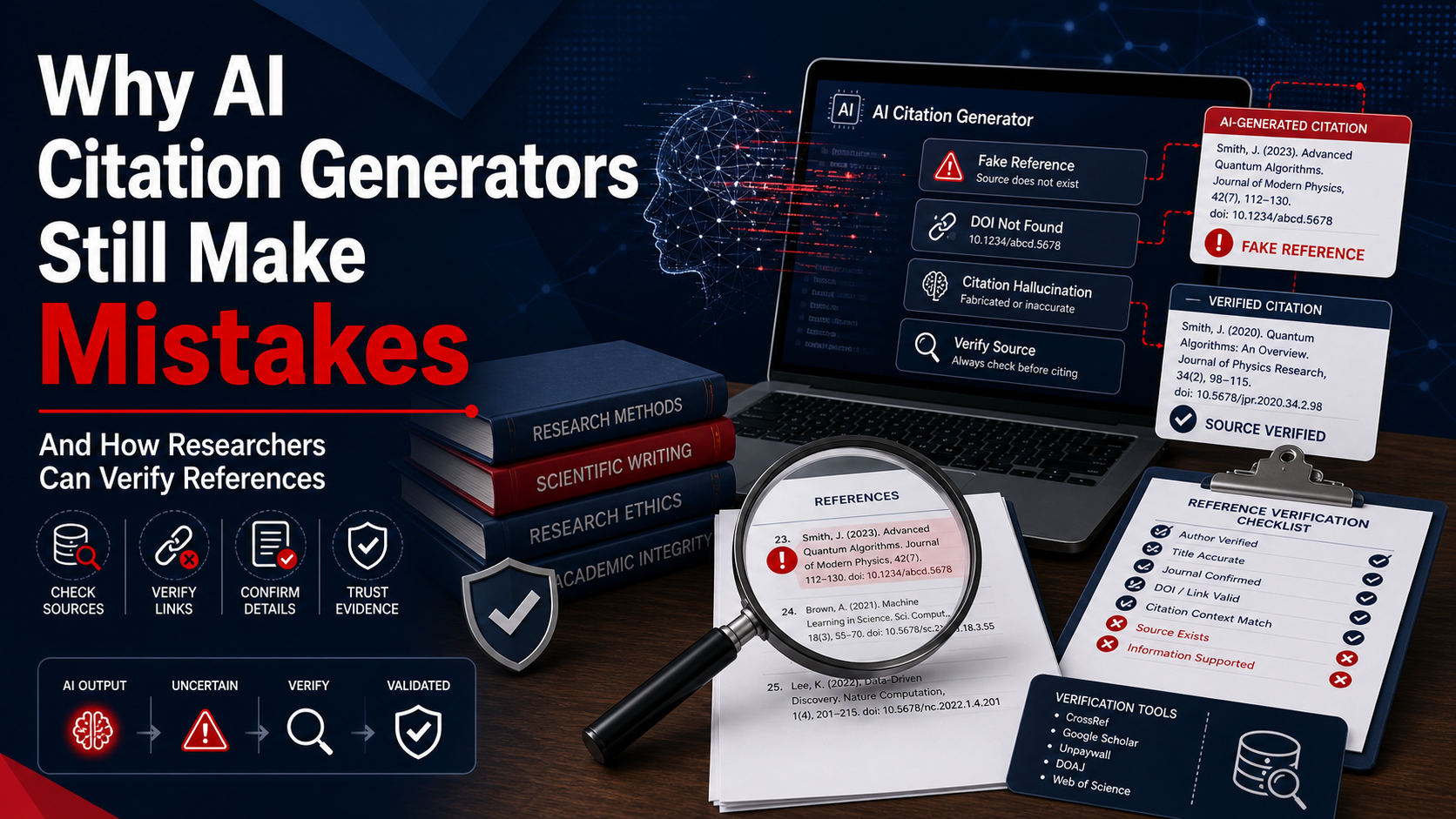
One of the most dangerous uses of generative AI in academic writing is asking an AI system to generate references without independently verifying them.
AI systems can produce references that look completely legitimate.
A generated citation may contain:
- A real author
- A plausible title
- A real journal
- A realistic year
- A convincing DOI
And yet the exact article may not exist.
This is commonly referred to as a hallucinated reference.
Even advanced AI systems can make citation errors.
JAMA Network's current guidance specifically warns against using AI tools to generate or format bibliographic references because of concerns about accuracy and integrity.
Elsevier also warns authors to carefully verify AI-generated references and notes that fabricated references can contribute to manuscript rejection.
The safest approach is straightforward:
Never copy an AI-generated citation directly into your manuscript without checking the original source.
Verify the paper independently using a reliable scholarly database or the publisher's website.
Can AI Be Listed as an Author?
No—not in the conventional sense of scholarly authorship.
AI systems cannot take responsibility for a manuscript, approve its final version, respond meaningfully to questions about research integrity, or accept accountability for the scientific record.
Major publisher policies therefore do not treat generative AI systems as authors or co-authors.
For example, Elsevier explicitly states that AI tools should not be listed as authors or co-authors because authorship requires responsibilities that can only be assigned to humans.
The responsibility remains with the human researchers.
This distinction matters because authorship is not simply about who "helped write" something.
Authorship carries accountability.
What If I Used AI but Didn't Disclose It?
This is where researchers should be careful.
Failure to disclose AI use when a journal requires disclosure can create a publication-compliance problem.
JAMA Network's current guidance states that incomplete or missing disclosure can result in rejection or postpublication corrective action if the use is detected.
This does not mean that every undisclosed use automatically constitutes research misconduct.
However, it does mean that researchers should take journal disclosure requirements seriously.
If you used AI substantially during manuscript preparation and are unsure whether disclosure is required, the safest approach is to review the current journal policy before submission.
If necessary, contact the journal's editorial office for clarification.
A Simple AI Disclosure Decision Framework
Before submitting your manuscript, ask these five questions.
Question 1
Did I use AI at all?
If no, there may be nothing to disclose.
If yes, continue.
Question 2
What did I use it for?
Was it:
- Grammar checking?
- Translation?
- Brainstorming?
- Literature searching?
- Manuscript rewriting?
- Data analysis?
- Coding?
- Image generation?
- Figure preparation?
Question 3
Did AI change the scientific content?
This is a critical distinction.
Changing spelling is very different from changing the interpretation of a result.
Question 4
Was AI part of the research methodology?
If yes, the use may need to be described as part of the research methods rather than treated simply as manuscript assistance.
Question 5
What does my target journal require?
This is the final checkpoint.
Do not submit until you understand the journal's current requirements.
AI Disclosure Is About Transparency, Not Shame
Some researchers hesitate to disclose AI use because they worry that editors or reviewers will automatically view the manuscript negatively.
That concern is understandable.
But responsible AI use and undisclosed AI use are two different things.
Using a tool transparently for an appropriate purpose is fundamentally different from:
- Fabricating research
- Inventing references
- Generating unsupported conclusions
- Misrepresenting AI output as original evidence
- Concealing prohibited AI use
The goal of disclosure is to make the publication process more transparent.
It does not replace scientific responsibility.
In fact, a researcher who clearly documents how AI was used demonstrates greater awareness of research integrity than someone who hides or misrepresents its use.
What Researchers Should Do Before Their Next Submission
Before submitting a manuscript in 2026, create a simple record of your AI use.
For each tool, note:
Tool:
Name of the AI platform or software.
Purpose:
Why you used it.
Date:
When you used it.
Manuscript section:
Which part of the manuscript was affected.
Extent of use:
Whether it provided suggestions, rewrote text, generated content, translated material, or supported analysis.
Human verification:
What you did to verify the output.
Keeping this record can make disclosure much easier later.
It also prevents the common situation where researchers reach the submission stage and cannot remember exactly which AI tools they used several weeks earlier.
The Bottom Line
AI is not automatically prohibited in academic publishing.
Nor is it automatically acceptable for every purpose.
The key is responsible use, transparency, verification, and compliance with the target journal's policy.
A useful way to think about it is:
AI can assist the researcher.
AI cannot assume the researcher's responsibility.
If AI is used as part of the research methodology, report it appropriately.
If AI is used substantially during manuscript preparation, check whether disclosure is required.
If AI is used only for basic spelling or grammar correction, some journals explicitly exempt such use from disclosure.
And regardless of how AI was used:
The authors remain responsible for the final manuscript.
What We'll Cover in Part 2
Understanding the rules is only the first step.
The next question is much more practical:
"What exactly should I write in my manuscript if I used AI?"
In Part 2, we'll cover:
- Where to put an AI disclosure statement
- Acknowledgments vs Methods vs figure legends
- What information to include
- How to disclose ChatGPT use
- How to disclose AI-assisted editing
- How to disclose AI translation
- How to disclose AI-assisted literature searching
- How to disclose AI-assisted coding or analysis
- How to disclose AI-generated or AI-assisted figures
- Ready-to-adapt AI disclosure statement examples
- Common disclosure mistakes researchers should avoid
👉 Continue to Part 2: [How to Write an AI Disclosure Statement for Your Research Paper: Examples & Templates]