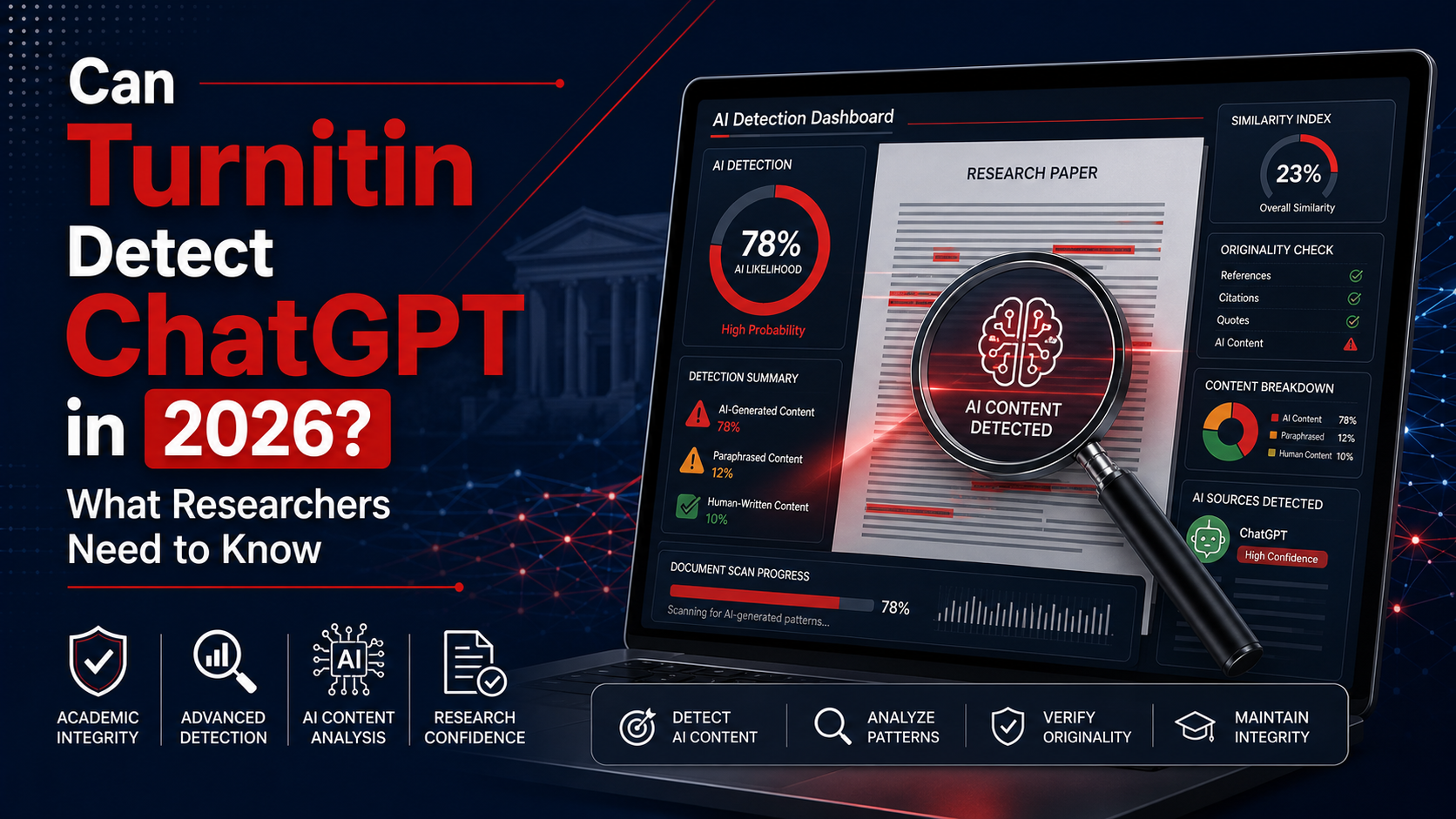
Can Turnitin Detect ChatGPT in 2026? What Researchers Need to Know
Artificial intelligence has rapidly become part of the modern research workflow.
Researchers now use tools such as ChatGPT, Claude, Gemini, Copilot, and other large language models to brainstorm ideas, improve writing clarity, summarize literature, generate code, and organize research projects.
However, one question continues to generate anxiety among students, PhD scholars, and researchers:
Can Turnitin detect ChatGPT-generated content?
The short answer is:
Sometimes. But not with complete accuracy.
Understanding what Turnitin can and cannot detect is essential for researchers who want to use AI ethically while avoiding academic integrity concerns.
Why This Question Matters
Since the release of ChatGPT in late 2022, universities worldwide have struggled to adapt their academic integrity policies.
Many institutions now permit limited AI-assisted writing, while others require disclosure of AI use.
As a result, researchers increasingly worry about:
• AI detection reports
• False positives
• Manuscript rejection
• Thesis evaluation
• Research misconduct allegations
The reality is more nuanced than many online discussions suggest.
What Is Turnitin's AI Detection System?
Turnitin originally became known for plagiarism detection.
Its traditional system compares submitted text against:
• Published literature
• Academic databases
• Student submissions
• Internet sources
• Institutional repositories
AI detection is different.
Rather than identifying copied text, Turnitin attempts to estimate whether text patterns resemble content generated by large language models such as ChatGPT.
The system analyzes linguistic patterns, including:
• Predictability of word choice
• Sentence structure consistency
• Language variation
• Statistical text characteristics
The result is an estimated AI-writing score.
Importantly:
Turnitin does not know whether ChatGPT was actually used.
It only estimates the probability that portions of the text resemble AI-generated writing.
Can Turnitin Reliably Detect ChatGPT?
The answer is:
No detection system is currently 100% reliable.
Multiple independent studies have demonstrated that AI detectors can produce both:
False Positives
Human-written content incorrectly flagged as AI-generated.
False Negatives
AI-generated content incorrectly identified as human-written.
This means that detection reports should never be treated as definitive proof.
Even Turnitin itself has acknowledged limitations and advises institutions to use AI detection reports as one factor among many when evaluating academic work.
Why AI Detection Is Difficult
Detecting AI-generated text is fundamentally harder than detecting plagiarism.
Plagiarism detection compares content against existing sources.
AI detection attempts to infer authorship based on writing patterns.
Several factors make this difficult:
1. AI Writing Is Constantly Improving
Modern models generate more natural and diverse text than earlier versions.
Each new generation becomes harder to distinguish from human writing.
2. Human Writing Can Resemble AI
Clear, structured, formal academic writing often appears statistically similar to AI-generated text.
This increases false-positive risk.
3. Human Editing Changes Detection Results
If a researcher substantially revises AI-assisted text, detection systems may struggle to identify any AI patterns.
4. Different AI Models Produce Different Outputs
ChatGPT, Claude, Gemini, and other systems generate text differently.
Detection tools cannot reliably identify which model produced specific content.
Can Turnitin Detect Edited ChatGPT Content?
This is where many misconceptions arise.
If someone copies and pastes raw AI-generated text without revision, detection systems may identify stronger AI-related patterns.
However, when a researcher:
• Rewrites sections
• Adds original analysis
• Incorporates domain expertise
• Revises sentence structure
• Integrates verified references
Detection becomes significantly less predictable.
This is one reason why universities increasingly focus on academic integrity rather than attempting to identify AI use purely through software.
What Researchers Should Really Be Concerned About
The biggest risk is often not detection.
The bigger risk is misuse.
Problems arise when researchers use AI to:
❌ Generate fake citations
❌ Invent data
❌ Fabricate results
❌ Write entire manuscripts without verification
❌ Conceal substantial AI involvement when disclosure is required
These practices can lead to serious academic consequences regardless of whether AI detection software flags the document.
Ethical AI Use in Research
Most major publishers now recognize that AI can assist researchers when used responsibly.
Acceptable uses often include:
✅ Grammar improvement
✅ Language refinement
✅ Summarization of existing literature
✅ Brainstorming research ideas
✅ Draft organization
✅ Coding assistance
✅ Search strategy development
Researchers remain fully responsible for:
• Accuracy
• Originality
• Interpretation
• Verification
• Ethical compliance
AI can support the research process.
It cannot replace scholarly responsibility.
🚀 FREE RESEARCHER RESOURCE
🔴 Download: AI in Research: The Complete Ethical Researcher's Guide (2026 Edition)
👆 Click here to access the free guide
A practical 80+ page guide covering:✅ Ethical AI use in research
✅ AI disclosure requirements
✅ Literature review workflows
✅ Prompt engineering for researchers
✅ Citation verification strategies
✅ Responsible AI implementationCreated by Beubenz Scientific Writing Services (BSWS) for researchers, PhD scholars, and academic professionals.
What Universities and Publishers Are Moving Toward
A major shift is occurring globally.
Rather than asking:
"Was AI used?"
Many institutions are asking:
"Was AI used responsibly and transparently?"
This approach reflects the reality that AI tools are becoming integrated into everyday academic workflows.
The emphasis is increasingly on:
• Disclosure
• Verification
• Accountability
• Research integrity
• Human oversight
Practical Advice for Researchers
If you use AI in your research workflow:
Do
✅ Verify every factual claim
✅ Check every citation manually
✅ Review all AI-generated content critically
✅ Follow journal-specific AI policies
✅ Disclose AI use when required
✅ Maintain authorship responsibility
Don't
❌ Generate references without verification
❌ Submit AI-produced text blindly
❌ Use AI to create research data
❌ Assume AI outputs are accurate
❌ Rely on AI detectors as proof of misconduct
The Real Question Researchers Should Ask
Many researchers ask:
"Can Turnitin detect ChatGPT?"
A better question is:
"Can I justify and defend every sentence in my manuscript?"
If the answer is yes, you are approaching AI use responsibly.
If the answer is no, the issue is not Turnitin.
The issue is research integrity.
Final Thoughts
Turnitin's AI detection technology continues to evolve, but no system can reliably determine with certainty whether ChatGPT was used to create a document.
Researchers should avoid focusing exclusively on detection scores.
Instead, focus on:
• Accuracy
• Transparency
• Verification
• Ethical AI use
The future of research is unlikely to be AI versus humans.
It will be researchers who know how to use AI responsibly versus those who do not.
The researchers who thrive in 2026 and beyond will be those who combine human expertise, critical thinking, and ethical AI practices to produce trustworthy scholarship.
Frequently Asked Questions
Is Turnitin 100% accurate at detecting ChatGPT?
No. Turnitin itself acknowledges limitations, and AI detection systems can generate both false positives and false negatives.
Can Turnitin tell which AI tool was used?
No. Detection systems generally estimate whether text resembles AI-generated content but cannot reliably identify a specific model such as ChatGPT, Claude, or Gemini.
Will rewriting ChatGPT output avoid detection?
Detection results become less predictable after substantial human revision. However, ethical use and transparency are more important than attempting to bypass detection systems.
Can journals reject papers because of AI use?
Some journals require disclosure of AI assistance. Failure to follow journal policies may create problems even if the manuscript itself is scientifically sound.
Should researchers stop using AI entirely?
No. Most institutions and publishers increasingly recognize responsible AI-assisted workflows. The key requirement is ethical use, verification, and compliance with journal policies.
Source Verification
This article is based on information obtained from:
• Official Turnitin documentation and guidance on AI writing detection
• COPE (Committee on Publication Ethics) guidance on AI use in scholarly publishing
• ICMJE recommendations regarding authorship and accountability
• Official publisher policies from Elsevier, Springer Nature, Wiley, IEEE, and Nature Portfolio
• Peer-reviewed discussions on AI-generated content detection and academic integrity
Last verified on: 23 June 2026